Showing posts with label Iraq. Show all posts

Saturday, 2 January 2016

God Of The Refugees

Christmas morning sermon 2015


There has been one story which as dominated the news this year, that is the refugee crisis.  Over 1 million refugees have made the perilous journey to Europe, the vast majority coming from Syria and Iraq. 
We are facing the biggest refugee crisis since WW2.  A report by the UN estimates that there are now 60 million people who have been forcibly displaced from their homes, and the rate of people fleeing for their lives is increasing.
For many refugees the journey to Europe took them across the sea, a dangerous journey at the hands of people smugglers which has resulted in the death of over 3,695 people. 
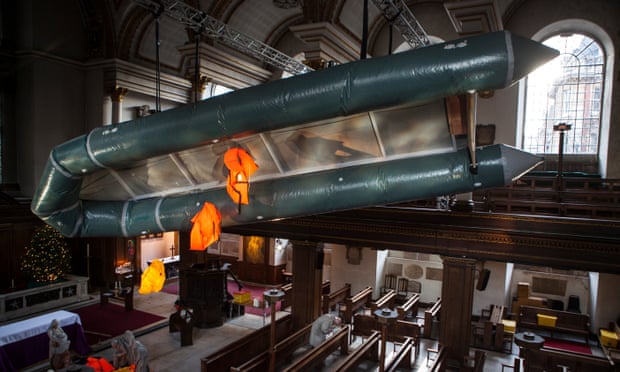
'Flight' by Arabella Dorman
Hanging from the vault of St James’ Church in Piccadilly, is an upturned refugee boat.  This dingy, designed to carry 15 people, transported 62 people from Turkey to Lesbos in Greece.  It is now an art installation by Arabella Dorman’s entitled Flight. The boat is suspended from the ceiling of the church, as if it were sinking down into the depths, and falling from its safety into the void are three life jackets: two adult-sized and one a child’s. The child’s has fallen further into the abyss, almost out of reach of the desperate parents.
So what does this have to do with Christmas?
You and I did not have any choice about when, where or how we came into the world. But God did.  And he left the comfort and splendour of his heavenly home, and chose to make himself weak and vulnerable, by being born as a human baby, totally reliant on others to feed and clothe him, to love him, care and protect him. 
He chose Mary, a young unmarried teenager, from a small, and insignificant village in Galilee to be the Mother of God.  And he chose a stable normally reserved for animals to be the place in which he entered the world, and for his bed a feeding trough. 
And the first witnesses to the birth of the Saviour of the World weren’t priests, or prophets, or politicians or Kings, people of power and influence but ordinary shepherds.  People who were looked down on by the rest of society, who because of their occupation were considered unclean, and therefore weren’t even allowed to enter the Synagogue or Temple.  Shepherds who weren’t even allowed to testify in court, because they were not trusted, and yet it was to these people that God choose to be the first witnesses of the birth of Jesus.
When God came into the world, it was in weakness and humility, so that he could identify and stand alongside the weak, the poor, the outcast, the stranger, and yes the refugee.  
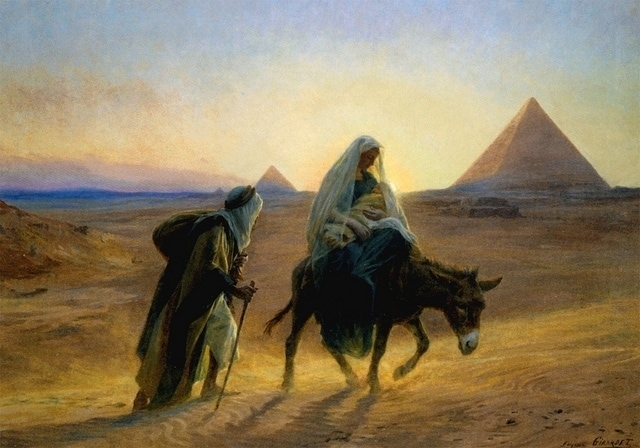
Flight into Egypt by Eugene-Alexis Girardet
Jesus himself knew what it was like to be a refugee.  He knew what it was like to face persecution, and to be forced from his home, like the tens of thousands of people in Iraq and Syria who have been forced to flee their homes to escape, persecution and death.  For Jesus the threat came from King Herod, who saw this small child as a threat to his throne.  King Herod, who had his wife and two sons killed, because he feared they were plotting against him.  So Mary, Joseph and Jesus were driven away from their home, to live in a foreign land. 
And even when Herod died, we are told that Joseph was afraid to take his family back to Judea, because Herod’s son Archelaus was ruling there, and so the family returned to Nazareth in the north.
Now understandably, we normally ignore the dark side of the nativity narrative. We have enough darkness of war and tragedy and refugees on our TV screens; some come to church at Christmas to escape from all of that and be reminded that Jesus is the light of the world. But Jesus can only be light if he shines where it is darkest.
When the angels declared the birth of Jesus to the shepherds they said “I bring you good news that will cause great joy for all the people.” (Luke 2:10)  It was into this dark and troubled world, that Jesus came to shine God’s light and love. 
The Christmas story is not some fairy tale, far removed from the reality of real life.  It is a real historical event that changed the world for ever.  And it is an event that has something important to say to a world where pain and tragedy, suffering and loss, is still a reality for many people, because Jesus, who is Emmanuel, God With Us, entered into the darkest places of brutal rulers and fleeing families. He walked a path of pain greater than probably any of us have experienced, culminating in his barbaric death at the hands of another brutal ruler, this time, one who was too weak-willed to protect a man he knew was innocent.
Sometimes people picture God lounging, perhaps dozing, in some celestial deck-chair, while millions struggle and die through war and famine and flood. But that is not the Christian God, that is not the God we worship this day. No, that terrible caricature of God in a celestial deck-chair is smashed to smithereens by the crib and the cross.
What’s your darkness at the moment? Maybe your darkness is job worries or relationship worries or health concerns. Whatever the darkness in your life at the moment, Jesus is God with us in the darkness.
And he brings light in the darkness - hope in the darkness - precisely because the darkness did not put Jesus out. Herod tried to extinguish the light of the world at his birth, but failed. Pilate tried to extinguish the light of the world at his death, but not even death could hold him down. So Jesus brings light in the darkness - hope in the darkness - because he’s confronted the darkness in our world and the darkness in our own hearts - he’s taken that evil onto himself, and let the darkness do its worst to him - and still he shines as the light for the world - light for you in your darkness.
Here’s the experience of one Syrian, who was forced to flee for his life after being threatened by ISIS fighters. Mathai walked from his home in Syria, to Damascus, across the border to Lebanon and into Turkey, then Greece. Traffickers put him on trains and a boat – a route where five people from his home town had previously drowned. He trekked through Macedonia, Serbia, Croatia and Hungary. He said, “Sometimes I was afraid, but mostly just so tired, so tired, so exhausted.” Two months ago Mathai finally arrived in Austria. Christians gave him a home and helped him apply for asylum. He was given an Arabic Bible. He said, “The Bible tells me I’m not alone, it reminds me that every human is loved by God and has a value. I’m very afraid, but when I turn to the Bible I see light. I particularly turn to passages in the Bible that are about forgiveness; it helps me when I think of all the people who have done awful things in my country, Jesus experienced the same and forgave his enemies. I am following Jesus.’’
Jesus brings light in the very darkest places. He wants to bring light in your darkness.  And he calls us to carry his light into the world, to follow his example and to stand in solidarity with the poor, the hungry, the frightened, the marginalized, the disadvantaged, the stranger, the outcast, the refugee.   
As the opening verses of John’s Gospel remind us, ‘In the beginning was the Word, and the Word was with God, and the Word was God.  He was with God in the beginning.  Through him all things were made; without him nothing was made that has been made.  In him was life, and that life was the light of all mankind.  The light shines in the darkness, and the darkness has not overcome it.’ (John 1:1-5)

May the light of Christ, shine in our lives, and in our world, now and forever more. Amen.

Wednesday, 10 September 2014

Matthew 8:18-22 The Cost Of Following Jesus

One of my favourite verses of scripture is John 10:10 ‘I have come that you may have life, and have it to the full.’  Jesus came, not just to give eternal life to those who believe in him, but to give us a life here on earth that is fuller and more abundant.  Our life on earth as Christians should be full of hope, joy, peace, love and fulfilment.  But this does not mean that the Christian life is easy. 

Jesus in our Gospel reading today makes it clear that following him is not an easy path to follow.  It was not easy 2,000 years ago and it is not easy today.  To be a follower of Christ can mean great cost and sacrifice.  Jesus said to his disciples “If anyone would come after me, let him deny himself and take up his cross and follow me.” (Matthew 16:24) That means dying to self and living for Christ, putting God first in our lives, and allowing God to take charge of our lives.  And that’s hard, really hard. 
I am by nature a very self-centred person, I tend to inhabit the Kingdom of Simon, where I am king, rather than the Kingdom of God, where Jesus is king.  I suspect that I’m not alone in this.  We live in a self-obsessed, self-centred world, where the focus seems to be on promoting ourselves, and putting ourselves first.  Therefore to be a Christian and to put God first goes against the values of our modern age, it is counter cultural.  To do this is not easy, I need to recommit myself to God afresh every single day, because I know that I fail in putting him first, but I also know that because he loves me he gives me a fresh start each day.  And whatever the sacrifices we are called to make in following Christ, the rewards far outweigh them.    
In our Gospel reading a scribe came to Jesus and said “Teacher I will follow you wherever you go”, Jesus replied “Foxes have holes, and birds of the air have nests, but the Son of Man has nowhere to lay his head.” (Mt 8:20).  Although Jesus had a home base in Capernaum, his travelling ministry left him and his disciples at the mercy of others’ hospitality, he was effectively homeless.  Matthew records Jesus’ words not only as a historical record, but also as a challenge for us today, what are prepared to sacrifice for the sake of following Jesus? 

Jesus makes it clear that commitment to him should take precedence over all other things.  Another person comes to him and says “Lord, let me first go and bury my father.” (Mt 8:21), but Jesus replies “Follow me, and leave the dead to bury their own dead.” (Mt 8:22) 

These words are probably not quite as harsh as they first seem.  It’s unlikely that this particular disciple was asking to attend his father's funeral later that day, the likelihood was that his father was not yet dead, and therefore he was requesting to wait until his father had died before following Jesus, which may have been years away. 

Another possibility is that there was a custom in Jesus’ day that the eldest son would return to the tomb a year after the father's death to "rebury" his father by neatly arranging his now bare bones in a container and sliding it into a slot in the wall. If the father of the man in Matthew's account had died, this young man might have been referring to his father's reburial, and asking for as much as a year's delay before following Jesus.
How different am I to the scribe?  There have been times when I have said to God ‘Lord I will go wherever you lead me, and do whatever you want me to do, BUT….’ and then come my list of terms and conditions. 
But what Jesus’ response shows is that he has to take the supreme position in our lives.  
Jackie Pullinger has devoted her life to working amongst the drug addicts and gangs in Hong Kong, which she started doing at the age of 21.  In a talk she said ‘God wants us to have soft hearts and hard feet. The trouble with so many of us is that we have hard hearts and soft feet.’ God wants us to have soft hearts – hearts of love and compassion. But if we are to make any difference to the world, this will lead to hard feet as we travel along tough paths and face challenges. Jackie is a glowing example of this in her willingness to go without sleep, food and comfort in order to serve others. This comes from a soft heart: a heart filled with compassion. The toughness is in her feet, not her heart. 
Len and Vera Russell speaking at St Martin’s said that after they had retired they felt God was calling them to be missionaries overseas, and they prayed “God we are prepared to serve you anywhere in the world, BUT not Africa.” So where did they end up?  Kenya.  Where they worked with the Africa Inland Mission for 14 years.  Despite their reservations they were willing to go where God sent them, they had soft hearts and tough feet. 
If we are serious about following Jesus, we will be called to make sacrifices; there will be a cost involved.  Jesus wants disciples, not church goers.  A disciple is one who wants to follow his master, become like him, and do the things he did, and if necessary to suffer for him. 
The costs and sacrifices we face in following Christ here in the UK, are small in comparison to what other Christians around the world are having to face. 
In our reading from Revelation Jesus warns the church in Smyrna that they are going to face persecution and he says to them ‘Be faithful, even to the point of death.’ (Revelation 2:10), and in John’s gospel Jesus warned his disciples “A servant is not greater than his master. If they persecuted me, they will persecute you also” (John 15:20).
Today around the world many Christians are paying the highest cost for following Jesus.    Imagine if over a ten year period you lost 1276 people from your church.  Not because they stopped coming to church, or decided to worship somewhere else, but because they were killed.  1276 people, men, women and children murdered.  
For Canon Andrew White, the Vicar of St George’s Church in Baghdad, the only Anglican church in Iraq, he doesn’t need to imagine this, this is what has happened to his congregation over the last ten years – and that was before the current crisis in Iraq.
In January the Catholic Online had the following headline Persecution ofChristians in the Middle East the worst ever in history The article went on to say The persecution of Christians in the Middle East is accelerating and nobody is paying attention. The rise in Islamic militancy is a by product of the Arab Spring and Christian minorities throughout the Islamic world are facing threats that until now, were considered unimaginable.Since this article was published, things have got a lot worse for Christians, with huge swathes of Iraq and Syria falling to the terrorist organisation the Islamic State. 
In June Mosul, the ancient biblical city of Nineveh fell to the Islamic State.  Mosul and the area surrounding it was the heartland of the Christian community in Iraq, and one of the world’s oldest Christian communities, but now that Christian presence has been eradicated.  Christians had a choice convert to Islam, pay a religious tax, or face death.  Most people have fled to the comparative safety of Kurdistan, and are living in desperate conditions in giant refugee camps.  Patriarch Louis Sako one of Iraq’s senior Chaldean Catholic clerics said in an interview in July “For the first time in the history of Iraq, Mosul is now empty of Christians.”
In 2003 before the Iraq War there were 1,500,000 Christians in Iraq, representing 5% of the population, that number is now estimated to have fallen to as low as 200,000 Christians.  What is happening in Iraq has been described as genocide – a deliberate attempt to wipe away all Christian presence from the Middle East. 
But it’s not just in Iraq, or Syria where Christian’s are being targeted, in Nigeria, Sudan and Kenya thousands of Christians have been kidnapped and killed by Boko Haram, and in Pakistan churches have been targeted by extremists.  And yet we hear so little about it in our news, and from our politicians.  In the New York Times this week Ronald S Lauder, president of the World Jewish Congress wrote ‘Why is the world silent while Christians are being slaughtered in the Middle East and Africa?’
Paul in 1 Corinthians 12:26 writes that we are the body of Christ and ‘If one part suffers, every part suffers with it; if one part is honoured, every part rejoices with it.’  Today the body of Christ is suffering.  These are our brothers and sisters in Christ who are being driven from their homes, and killed, we cannot stand by and do nothing.   
1 Stay informed
To pray effectively it is important to stay informed of what is taking place on the ground – follow the news, read CanonAndrew White’s blog, read and use the resources provided by Open Doors and the Barnabas Fund. 

2 Pray
Pray for the Iraqi Christians forced from their homes and under threat of death.
Pray for God’s protecting hand to be with them and his provision for them is plentiful in this time of urgent need.
Pray for those that are persecuting them

3 Write to your MP
Churches and individuals are being encouraged to write to their local MPs urging them to press the Government to increase Britain's humanitarian efforts for all those affected by the crisis and to ask for asylum to be granted to a fair number of those who will be unable to return to their homes.

4 Highlight the plight of Christians
Tools such as social media, can be used to highlight what is happening in the Middle East, and raise public awareness on what is happening.

On Twitter and Facebook many people have changed their profile pictures to the Arabic letter ‘N’, which has been daubed on the homes of Christians (often called 'Nasrani' in Arabic) in Mosul to identify them as targets for persecution or execution. Download a poster HERE.


This symbol has now been used to show solidarity with the Christians and other ethnic communities who have been targeted by the IS, and to champion freedom of religion and belief for all people. 

5 Give
To organisations and charities seeking to bring relief and aid to those displaced by the fighting.  Especially the Foundation For Relief and Reconciliation in the Middle East. 

In a speech in May Canon Andrew White said “People say ‘How do you keep going?’ And I think that I have said to my people so many times, ‘I’m not going to leave you, don’t you leave me’ and I can’t say that any more. Because I know that if my people stay they may be killed. I’ve seen so many of my people killed, and I’ve cried and cried and cried, because my loved ones are no more.  And one of our young girls turned around and said, ‘When you’ve lost everything Jesus is all you’ve got left, and we’ve lost everything. But we haven’t lost Jesus, he’s still there with us.’” 
If we are serious about following Jesus, whether that be in Walsall, Africa, China or the Middle East, there will be a cost involved.  But it is in taking up our cross and following Jesus, that we discover true life.  Jesus said “whoever loses their life for me will find it.” (Mt 16:25)  And though we may face hardships on the way, we have the reassurance that Jesus is still there with us. 

A video about St George's Church in Baghdad, filmed in 2012


Wednesday, 14 May 2014

Prayer for Wednesday 14th May

Today from our church family we pray for Ted Jones.
Collect for St Matthias:
Almighty God, who in the place of the traitor Judas chose your faithful servant Matthias to be of the number of the Twelve: preserve your Church from false apostles and, by the ministry of faithful pastors and teachers, keep us steadfast in your truth; through Jesus Christ our Lord. Amen.
Our prayers for Christian Aid Week today focus on Iraq. After years of turmoil and destruction, communities throughout Iraq are starting to rebuild their homes and their lives. Christian Aid partner Rehabilitation, Education and Community’s Health (REACH), is working alongside villagers to develop sustainable farming and commercial enterprises, building reservoirs and greenhouses so that villagers can enjoy year-round access to water and grow fresh fruit and vegetables. REACH also helps villagers lobby regional government for improved services and infrastructure, such as tarmac roads and electricity. We pray for all communities that are rebuilding after terrible disasters, and ask for your protection for the future, that peace will come and that their homes may never again be destroyed by war. Lord in your mercy, hear our prayer.

Friday, 11 April 2014

Prayer for Friday 11th April

Today from our church family we pray for John Duder.

Let us pray for Iraq, which continues to suffer from extreme violence and instability. We pray for Prime Minister Nouri Maliki and the government in Baghdad, and the leaders of the various provinces, ethnic and religious groups. We pray for an end to the violence between Sunni and Shia militias, and for the threat posed by the Al-Qaeda-linked Islamic State of Iraq and the Levant (ISIS). 

Congregation of St George's Baghdad

In particular we pray for the Christian community of Iraq, especially for Canon Andrew White and the congregation of St George's Baghdad.  

Canon Andrew White, Vicar of Baghdad

Since the start of the war in 2003, the Christian population in Iraq has fallen by two-thirds as hundreds of thousands have fled violence and persecution to seek refuge in neighbouring countries. We ask for your protection on all your children, and a new world of freedom and security for all. Lord in your mercy, hear our prayer.

Wednesday, 8 January 2014

Wednesday 8 January - Prayer

Two charities, US (the new name for USPG) and Embrace the Middle East have teamed up to provide support for Syrian refugees in Lebanon.  It is estimated that there are about 12,000 Syrian refugees in Lebanon.  Some arrive with a tiny number of personal possessions; most arrive with nothing at all.  The church network provides food aid and basic toiletries so that the money the refugees manage to earn doing menial jobs can be used for medical expenses and other emergencies.  This prevents them falling into debt and making a bad situation even worse.  Father God, bless and protect all the Christians fleeing persecution in Syria.  Thank you for the many organisations who are trying so hard to provide for the 4.5 million refugees in Lebanon, Jordan, Turkey, Iraq and Egypt.  Lord in your mercy, hear our prayer.