Showing posts with label Herod. Show all posts

Saturday, 2 January 2016

God Of The Refugees

Christmas morning sermon 2015


There has been one story which as dominated the news this year, that is the refugee crisis.  Over 1 million refugees have made the perilous journey to Europe, the vast majority coming from Syria and Iraq. 
We are facing the biggest refugee crisis since WW2.  A report by the UN estimates that there are now 60 million people who have been forcibly displaced from their homes, and the rate of people fleeing for their lives is increasing.
For many refugees the journey to Europe took them across the sea, a dangerous journey at the hands of people smugglers which has resulted in the death of over 3,695 people. 
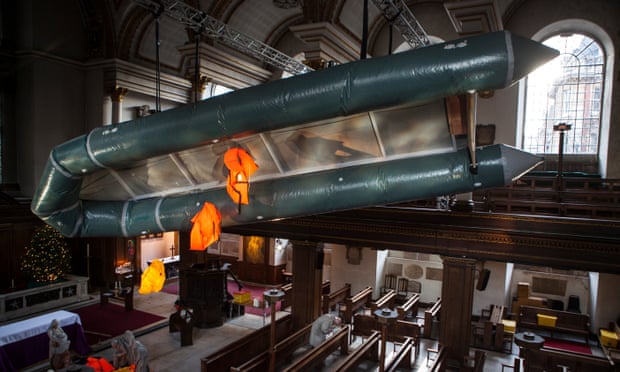
'Flight' by Arabella Dorman
Hanging from the vault of St James’ Church in Piccadilly, is an upturned refugee boat.  This dingy, designed to carry 15 people, transported 62 people from Turkey to Lesbos in Greece.  It is now an art installation by Arabella Dorman’s entitled Flight. The boat is suspended from the ceiling of the church, as if it were sinking down into the depths, and falling from its safety into the void are three life jackets: two adult-sized and one a child’s. The child’s has fallen further into the abyss, almost out of reach of the desperate parents.
So what does this have to do with Christmas?
You and I did not have any choice about when, where or how we came into the world. But God did.  And he left the comfort and splendour of his heavenly home, and chose to make himself weak and vulnerable, by being born as a human baby, totally reliant on others to feed and clothe him, to love him, care and protect him. 
He chose Mary, a young unmarried teenager, from a small, and insignificant village in Galilee to be the Mother of God.  And he chose a stable normally reserved for animals to be the place in which he entered the world, and for his bed a feeding trough. 
And the first witnesses to the birth of the Saviour of the World weren’t priests, or prophets, or politicians or Kings, people of power and influence but ordinary shepherds.  People who were looked down on by the rest of society, who because of their occupation were considered unclean, and therefore weren’t even allowed to enter the Synagogue or Temple.  Shepherds who weren’t even allowed to testify in court, because they were not trusted, and yet it was to these people that God choose to be the first witnesses of the birth of Jesus.
When God came into the world, it was in weakness and humility, so that he could identify and stand alongside the weak, the poor, the outcast, the stranger, and yes the refugee.  
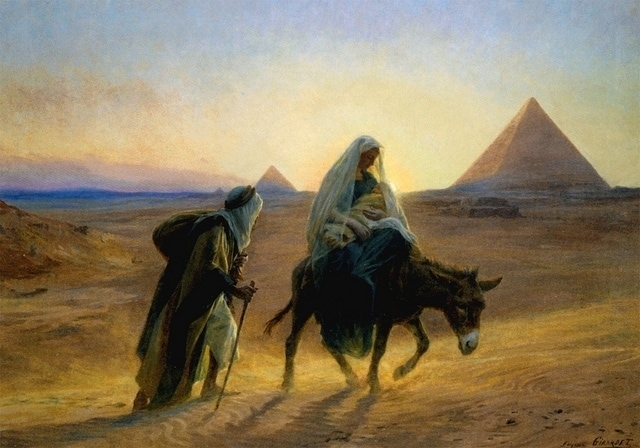
Flight into Egypt by Eugene-Alexis Girardet
Jesus himself knew what it was like to be a refugee.  He knew what it was like to face persecution, and to be forced from his home, like the tens of thousands of people in Iraq and Syria who have been forced to flee their homes to escape, persecution and death.  For Jesus the threat came from King Herod, who saw this small child as a threat to his throne.  King Herod, who had his wife and two sons killed, because he feared they were plotting against him.  So Mary, Joseph and Jesus were driven away from their home, to live in a foreign land. 
And even when Herod died, we are told that Joseph was afraid to take his family back to Judea, because Herod’s son Archelaus was ruling there, and so the family returned to Nazareth in the north.
Now understandably, we normally ignore the dark side of the nativity narrative. We have enough darkness of war and tragedy and refugees on our TV screens; some come to church at Christmas to escape from all of that and be reminded that Jesus is the light of the world. But Jesus can only be light if he shines where it is darkest.
When the angels declared the birth of Jesus to the shepherds they said “I bring you good news that will cause great joy for all the people.” (Luke 2:10)  It was into this dark and troubled world, that Jesus came to shine God’s light and love. 
The Christmas story is not some fairy tale, far removed from the reality of real life.  It is a real historical event that changed the world for ever.  And it is an event that has something important to say to a world where pain and tragedy, suffering and loss, is still a reality for many people, because Jesus, who is Emmanuel, God With Us, entered into the darkest places of brutal rulers and fleeing families. He walked a path of pain greater than probably any of us have experienced, culminating in his barbaric death at the hands of another brutal ruler, this time, one who was too weak-willed to protect a man he knew was innocent.
Sometimes people picture God lounging, perhaps dozing, in some celestial deck-chair, while millions struggle and die through war and famine and flood. But that is not the Christian God, that is not the God we worship this day. No, that terrible caricature of God in a celestial deck-chair is smashed to smithereens by the crib and the cross.
What’s your darkness at the moment? Maybe your darkness is job worries or relationship worries or health concerns. Whatever the darkness in your life at the moment, Jesus is God with us in the darkness.
And he brings light in the darkness - hope in the darkness - precisely because the darkness did not put Jesus out. Herod tried to extinguish the light of the world at his birth, but failed. Pilate tried to extinguish the light of the world at his death, but not even death could hold him down. So Jesus brings light in the darkness - hope in the darkness - because he’s confronted the darkness in our world and the darkness in our own hearts - he’s taken that evil onto himself, and let the darkness do its worst to him - and still he shines as the light for the world - light for you in your darkness.
Here’s the experience of one Syrian, who was forced to flee for his life after being threatened by ISIS fighters. Mathai walked from his home in Syria, to Damascus, across the border to Lebanon and into Turkey, then Greece. Traffickers put him on trains and a boat – a route where five people from his home town had previously drowned. He trekked through Macedonia, Serbia, Croatia and Hungary. He said, “Sometimes I was afraid, but mostly just so tired, so tired, so exhausted.” Two months ago Mathai finally arrived in Austria. Christians gave him a home and helped him apply for asylum. He was given an Arabic Bible. He said, “The Bible tells me I’m not alone, it reminds me that every human is loved by God and has a value. I’m very afraid, but when I turn to the Bible I see light. I particularly turn to passages in the Bible that are about forgiveness; it helps me when I think of all the people who have done awful things in my country, Jesus experienced the same and forgave his enemies. I am following Jesus.’’
Jesus brings light in the very darkest places. He wants to bring light in your darkness.  And he calls us to carry his light into the world, to follow his example and to stand in solidarity with the poor, the hungry, the frightened, the marginalized, the disadvantaged, the stranger, the outcast, the refugee.   
As the opening verses of John’s Gospel remind us, ‘In the beginning was the Word, and the Word was with God, and the Word was God.  He was with God in the beginning.  Through him all things were made; without him nothing was made that has been made.  In him was life, and that life was the light of all mankind.  The light shines in the darkness, and the darkness has not overcome it.’ (John 1:1-5)

May the light of Christ, shine in our lives, and in our world, now and forever more. Amen.

Friday, 20 December 2013

Christmas Talk 2013

When Walt Disney promised his daughters that he would make a movie of their favourite book ‘Mary Poppins’  he had no idea it would take 20 years to fulfil this promise.  What he hadn’t bargained for was the book’s author PL Travers, who did not want to see her beloved creation ruined by Hollywood.  The relationship between Walt Disney and PL Travers, and how Mary Poppins was brought to the big screen is told in the film ‘Saving Mr Banks’, which is currently showing in cinemas.  At the end of Saving Mr Banks, it gives the impression PL Travers came to accept and even like the film of Mary Poppins, but in reality she hated what the movie had done to her beloved character.  She accused Walt Disney of betraying her originally dark protagonist by turning her into the bundle of joy that was Julie Andrews.  The film is certainly different to the book.  In the book Mary Poppins is a no-nonsense, dark and disciplined character, who uses more self-discipline than magic, but this was lost in the film version.
You could argue that something similar has happened to the Christmas story.  Much of the story has been sanitised, with the darker, far more troubling elements in the nativity often ignored or overlooked.  For example most nativity scenes, whether performed in schools or churches, finish with the wise men visiting the infant Jesus.  But rarely do we go onto tell what happens next.  The Apostle Matthew records that “When Herod realized that he had been outwitted by the Magi, he was furious, and he gave orders to kill all the boys in Bethlehem and its vicinity who were two years old and under, in accordance with the time he had learned from the Magi.” (Mt 2:16).  Because of this, Mary, Joseph are forced to flee to Egypt with Jesus, where according to the Gospel of Matthew they stay until Herod’s death, before returning to Nazareth, because it was not safe for them to return to Bethlehem. 
You may say that this would not be appropriate to show or talk about at Christmas, especially if children are present.  But Herod plays an important part of the story and if we leave him in the Christmas narrative, we can address the shadow of evil hovering of Christmas to this day, in places like Syria, where the innocent are suffering and dying on a daily basis, and where the international community seems unable to bring an end to the bloodshed.  Herod still stalks the earth. 
It was into this dark, troubled, and violent world that Jesus, the one who laid the foundations of the earth (Hebrews 1:10), the one through whom all things were made (John 1:3), became Emmanuel, God with us. 
Because of the incarnation, in our darkest hours, in our saddest moments, when fear and violence and loneliness seem to rule the planet, we can take comfort that we are not alone.  That God entered human flesh, and lived as one of us.  
Dietrich Bonhoeffer, the German theologian who was killed by the Nazi’s shortly before the end of the Second World War, wrote, “We are no longer alone; God is with us.  We are no longer homeless; a bit of the eternal home itself has moved into us.”
Jesus came as the Light of the World, and as we heard in our reading from John’s Gospel, ‘The light shines in the darkness, and the darkness has not overcome.’ (John 1:5).  Because of Jesus, we have hope.  We have hope for the future, that we will be redeemed; hope for the present, that we are not alone.  He gives us hope even for the past, hope that our failures are not greater than God’s love.  And even as the smallest light can dispel darkness, so the light of Christ comes to dispel the darkness in our lives, and the darkness in our world. 
None of us had any choice over how or when we were born.  But God did, and he chose a simple stable.  In doing so, he announced in a dramatic way that he had come to be available to us all, and that he came to stand on the side of the poor, the weak, the disposed, the homeless, and those on the margins of society. 
If we idealise and over sentimentalise the nativity the danger is that it removes the birth of Jesus from the realities, and struggles of ordinary life. 
Rather than the romanticised manager that we tend to think about at Christmas, the stable or cave where Jesus was born would have been smelly, dirty, cold and untidy, and the manager he was placed in simple and crude, a very strange bed for a King to lie in.  Probably someone may have gone as far as to place clean straw under the baby, but elsewhere the straw on the floor would have been anything but fresh. On the wooden posts, there would be signs of where generations of animals had rubbed their itching, flea-bitten backs.  In Christina Rossetti’s carol In The Bleak Midwinter, she writes Our God, Heaven cannot hold Him nor earth sustain; Heaven and earth shall flee away when He comes to reign: In the bleak mid-winter a stable-place sufficed The Lord God Almighty, Jesus Christ.
We sometimes think that in order for Christ to enter our lives, we need first to get our lives all sorted out, and cleaned out.  But what the message of Christmas shows, is that just as Jesus was once born in a cold, dark, dirty, unrenovated barn, in a place normally reserved for animals, so he wishes to be born today in cold, dark, dirty, unrenovated hearts.  He does not postpone His birth in us until we have swept out the moral refuse. He comes to us as we are – into our broken, and less than perfect lives, with all our impatience, selfishness, evil thoughts, pride, deceit, and pretence.  We do not need to first sanitise our lives for Jesus to come in.  We don’t need to go in search of God, he came in search of us to rescue us by entering fully into the world.  This is the message of Christmas. Emmanuel: God with us.
And the question we need to ask ourselves is, are we going to allow Christ into our lives and to renew and refresh them, no matter how messy, or messed up they may be. Jesus today says “Here I am! I stand at the door [of your lives] and knock. If anyone hears my voice and opens the door, I will come in and eat with that person, and they with me.” (Rev 3:20).  Are we willing to allow Christ into our less than perfect lives afresh this Christmas, & let his light and love radiate out for all to see, just as God’s love radiated out of that lowly manger where Jesus lay?  

Thursday, 12 December 2013

Beyond the Tea Towels & Tinsel: What is Christmas About?

The following information below was written by Anne Le Bass, a priest in the south east of England, who put together this information about Christmas to help people understand what's in the story, and what isn't.  I've made a few small alterations to the tex. To download the original handout click HERE.

BEYOND THE TEA-TOWELS AND THE TINSEL: WHAT IS CHRISTMAS ABOUT?


For Christians the birth of Jesus is more than just a comforting story to brighten up a dark time of year. Nor is it a story primarily for children (or even necessarily suitable for children if we take it seriously). It encapsulates important themes in Christian belief.

DID IT HAPPEN?

Jesus certainly existed. There is no credible reason why anyone should invent him. No one in the earliest days of the church would have risked their life to follow a fictional character, so the Church would never have got off the ground if he hadn’t been real. Many of those who wrote the books that we now call the New Testament, although they may not have known Jesus themselves, knew people who had done.

If Jesus existed, he must, therefore, have been born. His first followers, however, do not seem to have been very worried about the circumstances of his birth. It wasn’t important to them. It isn’t referred to in the Epistles, most of which were written before the Gospels, and very little, if anything, essential to Christian faith depends on the details of Jesus’ birth.

Only two of the Gospels record any birth stories (Matthew, who tells the story of the Magi and Luke, who tells the story of the shepherds). There are interesting differences between the two versions, though that doesn’t stop us squashing them together in Nativity plays. Matthew, for example, has the Holy Family escaping to Egypt after the Magi’s visit. Luke has them apparently going back to Nazareth via Jerusalem when he is six weeks old. In Matthew the news that Mary is pregnant is announced to Joseph in a dream – Mary is not consulted, and her views are not recorded. In Luke the angel comes to Mary, and she is a major player in the story.

WHAT’S IN THE STORIES, AND WHAT ISN’T?

Matthew
Starts with a genealogy which begins with Abraham, the father of the Jewish people. God had
made a covenant with him, that he would be the father of a multitude, God’s chosen people.
Matthew’s genealogy aims to show that Jesus is the true inheritor of that promise ; those who
follow him aren’t being traitors to their tradition. There are lots of reminders in the story of Old
Testament prophecies, (see, for example 1.23, 2.6, 2.15, 2.17, 2.23) These serve the same
purpose – Jesus isn’t an interloper, betraying the heritage of the Jewish people.

The genealogy includes 5 women. The first four could all in some way be regarded as unlikely
or even dodgy – outsiders in some way (Tamar, Rahab, Ruth, Bathsheba ). They are all,
however, vital links in the chain – God uses them to advance the story, to keep the line going.
The final woman is Mary, who, it is plain was also regarded as an unlikely mother for a
Messiah.

Matthew continues with the annunciation of Mary’s pregnancy to Joseph (Mary’s reaction
is not recorded). He decides to stand by her, though others may think that this reduces his
dignity. Like the four earlier women in the genealogy, God works through an unlikely channel.

Jesus is born in Bethlehem, but we’re not told that the family have travelled there – the
assumption is that they lived there all along. There is no stable or any suggestion that there was
“no room at the inn”. There is no mention of Nazareth until the end of the story, when Joseph
takes Mary and Jesus there on their return from Egypt, apparently because he feels it will be
safer than Bethlehem.

Herod and the Magi. The magi are only in Matthew. We’re not told how many of them there
are, and they are not kings. There are no camels…! Their significance is that they are outsiders
– Gentiles – and that they see the true identity of the Messiah when the Jewish rulers don’t. God
works through outsiders (like Ruth in the genealogy) if his own people don’t see him.

The flight into Egypt and the massacre of the children of Bethlehem. Jesus is seen as a
challenge to the power of Herod. He is a new king. Matthew’s story has been called the story of
two kings (Herod and Jesus) and some wise men.

The return from Egypt after the death of Herod to Nazareth – a new home for Joseph and
Mary, not a return to an old home.

Luke
The annunciation in the Temple of the birth of John the Baptist to Zechariah by an angel.
He and his wife Elizabeth are elderly and childless. Zechariah can’t believe it and is struck
dumb until John is born.

The annunciation of birth of Jesus to Mary by an angel (Joseph’s reactions are not
recorded). They are living in Nazareth, which is, apparently their home town.

Mary’s visit to Elizabeth. Elizabeth greets Mary as “the mother of my Lord”. Mary speaks
words (called the Magnificat in later Christian tradition) which praise God because he “has
brought down the powerful from their thrones and lifted up the lowly”).

The birth of John the Baptist and his naming. At which Zechariah speaks the words known
to later tradition as the Benedictus, announcing that this child will announce the time when the
people of Israel will “be saved from our enemies and from the hands of all that hate us” and “ by
the tender mercy of our God , the dawn from on high will break upon us, to give light to those
who sit in darkness and in the shadow of death, to guide our feet into the way of peace.”)

The birth of Jesus is set against a backdrop of political oppression in the rule of Caesar
Augustus. There is no record of a universal census at this time, but the point is that the people
of Israel are subject to the whims of rulers who can decree that they should all traipse about the
country for no very good reason.

The journey to Bethlehem. There is no donkey, nor any scenes of them going from inn to inn
and being turned away. There is no innkeeper (grumpy or otherwise).  The word translated as
"inn", is in fact a mistranslation, and more likely refers to an upper room in a family home.  It is
likely Joseph had relatives in Bethlehem, and they would have stayed with them, but because
the upper room was occupied, it meant the couple had to sleep downstairs in the open living
space where animals were kept at night for safety and where they ate from troughs dug into the
earth at one end of the room. Whilst nativity scenes depict a stable, it could have been a cave.  
There are no oxen, no cattle lowing (or doing anything else), no cats, dogs, birds, mice nor any
other animals. 

The annunciation to the shepherds. More angels. Opinions vary on the significance of the
shepherds. Some commentators say that they were regarded as the lowest of the low – living
out in the fields with the flocks meant they couldn’t keep the purity laws. Others suggest that
these shepherds may have been looking after the sheep used for sacrifice in the Temple in
Jerusalem (not far away) and so are a reference to Jesus’ self sacrifice (the Lamb of God who
is sacrificed, in the thought of the time, to end all sacrifice), or are a comment on the failure of
the Jewish religious leaders who should be “the shepherds of God’s flock”. There could also be
echoes of the story of Moses, who was looking after his father in law’s sheep when he
encountered God in the burning bush – once again unlikely people encounter God in an unlikely
way and begin a chain of events that will lead to a new liberation.

The circumcision and naming of Jesus. "Jesus” is a form of the name Joshua, which
means “God saves”. Joshua was the OT hero who succeeded Moses and led the Hebrews into
the Promised Land after the Exodus. Naming is important in this story – see the debate around
the naming of John, whose name means “God has given grace”.

The presentation of Jesus in the Temple at 40 days old. The sacrifice was a religious
requirement. Those who could afford it were to bring a lamb, but a pair of pigeons or
turtledoves was the permitted “budget” sacrifice for those who couldn’t. This tells us that Mary
and Joseph weren’t rich.

Simeon and Anna, devout elderly people who have been “looking for the redemption of Israel”
(i.e. the coming of the Messiah) acclaim Jesus, who no one else has noticed. They bring to an
end the series of moments of “recognition” or annunciation which we have seen in Luke’s
account.
  
For the sake of completeness…

MARK’S Gospel begins with the adult John the Baptist announcing the beginning of Jesus’ ministry. He makes no reference to Jesus’ birth, except in a curious aside, (6.3) when Jesus is referred to by a hostile crowd as “Mary’s son”. It wouldn’t have been normal to refer to someone as the son of their mother, rather than their father, unless they were illegitimate, or their parentage in some way dubious. Mark’s Gospel is almost certainly the earliest, and may, therefore preserve an early rumour that Jesus was conceived out of wedlock, which would have meant he was regarded with suspicion and disapproval.

JOHN’S Gospel begins with the famous passage, “In the beginning was the Word and the Word was with God, and the Word was God….and the Word was made flesh and lived among us.” It is a meditation on the significance of Jesus, who was God’s expression of himself, in John’s thinking, bringing light and life to the world. However “he came to what was his own, and his own people did not accept him.” John’s writing, late in the first century, is heavily tinged with Greek thinking. For him Jesus is, in some sense, a pre-existing divine figure; the other Gospels spell out far less clearly what they mean when they call him the “Son of God”.

THEOLOGICAL THEMES OF THE CHRISTMAS STORY FOR CHRISTIANS

Incarnation
For Christians the birth of Jesus speaks of God being present on earth in a way which we can see and touch, in human flesh (carnosus means fleshy ) subject to all the things that happen to human flesh – including suffering and death. Because we know that he has experienced what we experience we feel that he can understand and help us.

One of the titles given to Jesus in the birth stories is “Emmanuel” which means “God is with us.”

Incarnation is also significant for Christians because we see in it God putting aside his glory and coming among the least and the lowest (coming down to earth literally) “Let the same mind be in you that was in Christ Jesus, who, though he was in the form of God,  did not regard equality with God   as something to be exploited, but emptied himself, taking the form of a slave, being born in human likeness. And being found in human form, he humbled himself and became obedient to the point of death — even death on a cross. (Philippians 2.5-8)

The Kingdom of God
The Christmas story represents a new beginning, the coming (“advent”) of God’s Messiah to bring in a new kingdom. During the preparation for Christmas (Advent) we think about the ways in which we still need God to come to us. We think about issues of peace and justice, forgiveness and reconciliation. This is why Advent is a time of reflection and penitence – during it we become aware of our needs and the needs of the world. The Nativity stories have a strong element of challenge in them to the status quo of the world in which they happen – the Roman and Jewish rulers fail to see, or to stop, the birth of this “new king”.

The Word of God. Jesus is seen as God’s expression of himself. He had spoken through the prophets in the Old Testament, but now he speaks through a son, someone who in some way “embodies” his message. It’s not words, but the Word. Knowing God through a person is very different to knowing him in words – people are deep, subtle, responding in different ways to different circumstances, growing, learning and changing; they can’t be reduced to lists of rules and instructions. 

CELEBRATING ADVENT AND CHRISTMAS

ADVENT begins on the fourth Sunday before Christmas (not Dec 1). The colour of altar hangings, vestments etc. is purple (or blue in some traditions), and it is a penitential season, when the emphasis is on awareness of what needs to change in the world and in us.

During Advent we sing special Advent hymns, although inevitably Christmas hymns and celebrations creep into the Advent season!

Many churches use Advent candles – four candles for the four Sundays, plus a fifth lit at the first Communion service of Christmas. The Christmas candle is white, the others are either all red, or three purple and one pink (for the third Sunday in Advent- Gaudete, or “rejoicing” Sunday).

Other Advent traditions are the Advent candle, with 24 markings to burn through during December, Advent calendars and the Jesse tree, which uses symbols of Old Testament stories, told each day, to lead up to Christmas.

CHRISTMAS begins at the first celebration of Communion for Christmas. In many churches this happens on Christmas Eve, shortly before midnight (Midnight Mass). The altar hangings, vestments etc. are gold or white.

There is often a crib scene in the church (ours is put together at the Crib service on Christmas Eve afternoon).

The Christmas season in church lasts until CANDLEMAS, on Feb 2, the feast of the Presentation of Christ in the Temple. It includes the feast of EPIPHANY on Jan 6, when we remember the visit of the Wise Men, and the weeks after that (sometimes called Epiphanytide) which focus on stories of people becoming aware of Jesus (Epiphany means manifestation, or showing).

CHRISTINGLES are a Moravian tradition, quite recently used in this country, often in aid of the Children’s Society; a Christingle service can take place at anytime during the Advent or Christmas seasons.

Wednesday, 22 December 2010

Herod & the Wise Men: Matthew 2:13-23


If you have ever attended a performance of a nativity play, chances are that whilst it featured shepherds and wise men, it probably didn't include the story of the what is often referred to as the 'slaughter of the innocents', the brutal murder of children in Bethlehem by King Herod. This event is an integral part of the Christmas story, but we tend to ignore it because it doesn't sit comfortably with the nice image that we have of the birth of Jesus, of angels, shepherds and wise men. People often say 'Christmas is for the children', but we clearly feel that this part of the story isn't for them.


This part of the nativity story, the visit of the wise men and King Herod's subsequent attempt to destroy Jesus, is uncomfortable and disturbing, but shouldn't be done away with.


There is a great contrast between the reaction of the wise men to the birth of Jesus and Herod's reaction. So what do we know about the wise men and Herod?


The Bible tells us very little about the wise men, or as Matthew refers to them, magi. It doesn't even say how many there were, or who they were. All Matthew tells us was that they had seen a special star and had travelled from the East. The likelihood is that they were astronomers, who would have been extremely important in an agricultural society, because they would have predicted the best times for planting crops, would have known maths and calendar systems, and would have been able to navigate using the stars. Although someone did observe that they must have been male, because if they had been wise women they would have asked for directions, arrived on time, helped deliver the baby, cleaned the stable, brought a casserole and given the baby much more practical gifts!


In contrast to the wise men, we know a lot about King Herod. Herod was born around 74BC and died in 4BC, and ruled Judea for 34 years, with the backing of the Romans. Herod could be extremely brutal, for example he had his wife and two of his sons killed when he feared they were plotting to over throw him. The Jewish historian Josephus wrote that Herod was so concerned that no one would mourn his death, that he gave orders to have distinguished men killed at the time of his death so that the displays of grief that he craved would take place. But Herod also left behind another legacy, during his reign he oversaw many great building projects, some of which we can still see to this day. Amongst his 'greatest' achievements was the rebuilding of the temple in Jerusalem.


The response to the birth of Jesus of the wise men and Herod could not have been more different.


The magi on seeing the star that signalled the birth of Jesus travelled a great distance to find Jesus. It would have been a long, arduous and potentially dangerous journey that would have lasted many weeks. We are accustomed to thinking that the greatest gift of the magi was gold, frankincense and myrrh. It wasn't. The greatest gift they brought was their devotion, their willingness to endure whatever it took and to search for this new king. Their physical gifts paled in comparison. Maybe this is the most important lesson that we can learn from them. There must have been moments on their journey when faced by cold, hunger, danger, or simply the enormity of the journey ahead of them, that they thought about giving in, and returning to their homes, but they didn't. They kept on searching for Jesus until they found him.


When they eventually arrived in Bethlehem, after first stopping to see King Herod in Jerusalem, what they discovered was a small child and his parents, not surrounded by the trappings of wealth, power or privilege that you would normally expect royalty to have, but living in very humble ordinary surroundings. But despite the outward appearances, they recognised Jesus as the Messiah, and kneeled down and worshipped him.

The magi show us what worship is really about.
To worship something, is to that thing worth, it literally means worth-ship. So when we worship God, we give him the recognition that he deserves. If we look in Scripture we see that the central understanding of worship is to homage and submission to God, it is about service to God, it is therefore all encompassing, it is about our whole life, and it is about reverence for God. This is why Paul in Romans 12:1 writes, "Therefore, I urge you, brothers, in view of God's mercy, to offer your bodies as living sacrifices, holy and pleasing to God—this is your spiritual
act of worship." Our worship to God is expressed in the way we live.

The contrast between the response of the magi and Herod could not be greater. Whereas the magi were prepared to travel hundreds of miles to worship Jesus, Herod, could not be bothered to travel five miles to pay him a visit. Instead on hearing about the birth of the new king of the Jews, Herod was disturbed. Herod was hated in Israel, although he bore the title King of the Jews, he was in fact a puppet of the Roman Empire, and was generally despised in Israel for his cruelty. And so, on hearing about this new king, Herod probably feared for his own safety, he was more concerned about maintaining his power and his influence. Herod probably recognised that the Jewish people held little loyalty to him, and so he perceived this new king as a threat. And so rather than worshipping Jesus as the Saviour of the world, he sent out to destroy Jesus, by ordering that all children in Bethlehem under the age of two be murdered.


Herod's response to Jesus was one of hatred and fear, hatred of anything and anyone that threatened his self-centredness. The great tragedy is that there are people like Herod still in the world to this day, who are more intent on destroying Jesus and his followers, than coming to worship him. Someone wrote, "If we leave Herod in the Christmas narrative, we can address the shadow of evil hovering over Christmas to this day. Herod still stalks the earth. He may be disguised in the military fatigues of a dictator. He murders street child in Brazil by sending death squads when darkness falls. Herod sells Thai children as prostitutes to wealthy westerners. He detonates a car bond that kills innocent people." But it is Herod's whole sale rejection of Jesus, which is the tragedy which continues to this day. Cardinal Cormac Murphy-O'Connor writing in a book called 'Faith in the Nation' published last month, claims that the rise of secularism has led to a liberal society, hostile to Christian morals and values, in which religious belief is viewed as "a private eccentricity" and the voice of faith groups is marginalized." He goes on to say, "There are now "serious tensions" between Christians and secularist society, he says, in which atheists are becoming more "vocal and aggressive." We see in Matthew's Gospel the consequence of Herod's rejection of Jesus, and I believe today as a society we are living with the consequences of what happens when people reject God, with the break down of social cohesion in many of our communities, of many young people living without a moral compass to guide and direct them.


What in many ways was even more surprising than Herod's rejection of Jesus, was the response of the Jewish chief priests and scribes. They knew their Scriptures and had no problem in answering Herod when he wanted to know where the child would be born. But did they go to greet him? Did they lift a sandal? Not at all. They knew it all, but they did nothing. Their response, or lack of it, is surely a warning to us all. Their apathy hardened into outright opposition to Jesus as his ministry developed. Their response to the news of the birth of the messiah acts as a warning that knowledge is no substitute for obedience.


There is a great contrast between the response of the Magi and that of Herod to the birth of Jesus. The magi's faith, their insight and their whole hearted search and adoring worship of Jesus is something that should humble us all. Once the magi found Jesus, their lives took a different direction, one that is responsive to and obedient to God's call. So as we move away from Christmas and into the New Year, are we willing to seek him out and be led in a different way, like the wise men of old? Wise men and women still search for Jesus, will we do the same this year?