Showing posts with label Sermons From Gospel of Luke. Show all posts

Saturday, 2 January 2016

God Of The Refugees

Christmas morning sermon 2015


There has been one story which as dominated the news this year, that is the refugee crisis.  Over 1 million refugees have made the perilous journey to Europe, the vast majority coming from Syria and Iraq. 
We are facing the biggest refugee crisis since WW2.  A report by the UN estimates that there are now 60 million people who have been forcibly displaced from their homes, and the rate of people fleeing for their lives is increasing.
For many refugees the journey to Europe took them across the sea, a dangerous journey at the hands of people smugglers which has resulted in the death of over 3,695 people. 
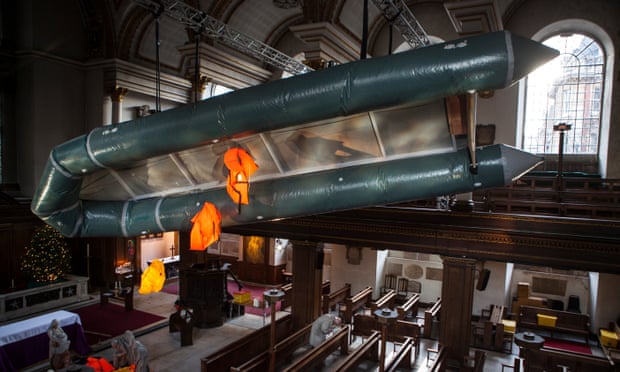
'Flight' by Arabella Dorman
Hanging from the vault of St James’ Church in Piccadilly, is an upturned refugee boat.  This dingy, designed to carry 15 people, transported 62 people from Turkey to Lesbos in Greece.  It is now an art installation by Arabella Dorman’s entitled Flight. The boat is suspended from the ceiling of the church, as if it were sinking down into the depths, and falling from its safety into the void are three life jackets: two adult-sized and one a child’s. The child’s has fallen further into the abyss, almost out of reach of the desperate parents.
So what does this have to do with Christmas?
You and I did not have any choice about when, where or how we came into the world. But God did.  And he left the comfort and splendour of his heavenly home, and chose to make himself weak and vulnerable, by being born as a human baby, totally reliant on others to feed and clothe him, to love him, care and protect him. 
He chose Mary, a young unmarried teenager, from a small, and insignificant village in Galilee to be the Mother of God.  And he chose a stable normally reserved for animals to be the place in which he entered the world, and for his bed a feeding trough. 
And the first witnesses to the birth of the Saviour of the World weren’t priests, or prophets, or politicians or Kings, people of power and influence but ordinary shepherds.  People who were looked down on by the rest of society, who because of their occupation were considered unclean, and therefore weren’t even allowed to enter the Synagogue or Temple.  Shepherds who weren’t even allowed to testify in court, because they were not trusted, and yet it was to these people that God choose to be the first witnesses of the birth of Jesus.
When God came into the world, it was in weakness and humility, so that he could identify and stand alongside the weak, the poor, the outcast, the stranger, and yes the refugee.  
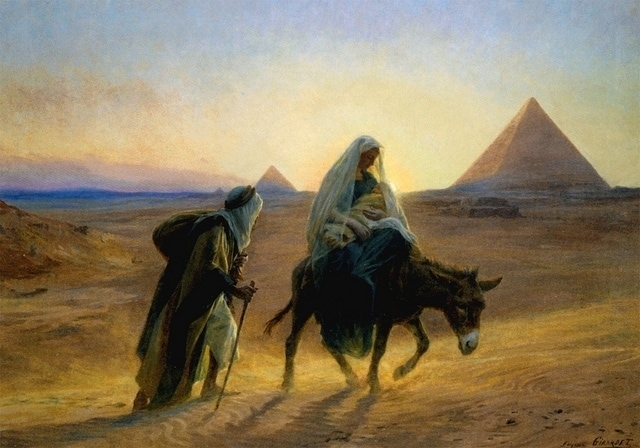
Flight into Egypt by Eugene-Alexis Girardet
Jesus himself knew what it was like to be a refugee.  He knew what it was like to face persecution, and to be forced from his home, like the tens of thousands of people in Iraq and Syria who have been forced to flee their homes to escape, persecution and death.  For Jesus the threat came from King Herod, who saw this small child as a threat to his throne.  King Herod, who had his wife and two sons killed, because he feared they were plotting against him.  So Mary, Joseph and Jesus were driven away from their home, to live in a foreign land. 
And even when Herod died, we are told that Joseph was afraid to take his family back to Judea, because Herod’s son Archelaus was ruling there, and so the family returned to Nazareth in the north.
Now understandably, we normally ignore the dark side of the nativity narrative. We have enough darkness of war and tragedy and refugees on our TV screens; some come to church at Christmas to escape from all of that and be reminded that Jesus is the light of the world. But Jesus can only be light if he shines where it is darkest.
When the angels declared the birth of Jesus to the shepherds they said “I bring you good news that will cause great joy for all the people.” (Luke 2:10)  It was into this dark and troubled world, that Jesus came to shine God’s light and love. 
The Christmas story is not some fairy tale, far removed from the reality of real life.  It is a real historical event that changed the world for ever.  And it is an event that has something important to say to a world where pain and tragedy, suffering and loss, is still a reality for many people, because Jesus, who is Emmanuel, God With Us, entered into the darkest places of brutal rulers and fleeing families. He walked a path of pain greater than probably any of us have experienced, culminating in his barbaric death at the hands of another brutal ruler, this time, one who was too weak-willed to protect a man he knew was innocent.
Sometimes people picture God lounging, perhaps dozing, in some celestial deck-chair, while millions struggle and die through war and famine and flood. But that is not the Christian God, that is not the God we worship this day. No, that terrible caricature of God in a celestial deck-chair is smashed to smithereens by the crib and the cross.
What’s your darkness at the moment? Maybe your darkness is job worries or relationship worries or health concerns. Whatever the darkness in your life at the moment, Jesus is God with us in the darkness.
And he brings light in the darkness - hope in the darkness - precisely because the darkness did not put Jesus out. Herod tried to extinguish the light of the world at his birth, but failed. Pilate tried to extinguish the light of the world at his death, but not even death could hold him down. So Jesus brings light in the darkness - hope in the darkness - because he’s confronted the darkness in our world and the darkness in our own hearts - he’s taken that evil onto himself, and let the darkness do its worst to him - and still he shines as the light for the world - light for you in your darkness.
Here’s the experience of one Syrian, who was forced to flee for his life after being threatened by ISIS fighters. Mathai walked from his home in Syria, to Damascus, across the border to Lebanon and into Turkey, then Greece. Traffickers put him on trains and a boat – a route where five people from his home town had previously drowned. He trekked through Macedonia, Serbia, Croatia and Hungary. He said, “Sometimes I was afraid, but mostly just so tired, so tired, so exhausted.” Two months ago Mathai finally arrived in Austria. Christians gave him a home and helped him apply for asylum. He was given an Arabic Bible. He said, “The Bible tells me I’m not alone, it reminds me that every human is loved by God and has a value. I’m very afraid, but when I turn to the Bible I see light. I particularly turn to passages in the Bible that are about forgiveness; it helps me when I think of all the people who have done awful things in my country, Jesus experienced the same and forgave his enemies. I am following Jesus.’’
Jesus brings light in the very darkest places. He wants to bring light in your darkness.  And he calls us to carry his light into the world, to follow his example and to stand in solidarity with the poor, the hungry, the frightened, the marginalized, the disadvantaged, the stranger, the outcast, the refugee.   
As the opening verses of John’s Gospel remind us, ‘In the beginning was the Word, and the Word was with God, and the Word was God.  He was with God in the beginning.  Through him all things were made; without him nothing was made that has been made.  In him was life, and that life was the light of all mankind.  The light shines in the darkness, and the darkness has not overcome it.’ (John 1:1-5)

May the light of Christ, shine in our lives, and in our world, now and forever more. Amen.

Sunday, 27 September 2015

Hearing, Listening & Acting

Now Jesus’ mother and brothers came to see him, but they were not able to get near him because of the crowd. Someone told him, “Your mother and brothers are standing outside, wanting to see you.” He replied, “My mother and brothers are those who hear God’s word and put it into practice.” Luke 8:19-21

I’m very blessed to be married to a wonderful woman called Beata.  But if you were to ask her about what irritates her most about me, I suspect she would tell you it’s my poor listening skills.  The trouble is when she talks to me, I hear her, but I don’t always listen. 

There is a big difference between hearing someone and listening to them.  As God complains to the people of Israel in Isaiah “You have seen many things, but you pay no attention; your ears are open, but you do not listen." (Is. 42.20)

I imagine we have all had the experience of talking to someone whose attention has not been on us, but on someone or something else, or who is more interested in getting their point of view over than listening to what we have to say. 

In contrast think to a time when you have felt as though you have been properly listened to.  That person would have given you their undivided attention.  You will feel as though you have been understood, and that the person listening to you has responded in some way to what you have said. 

In our Gospel reading today, Jesus makes the point that his true family are those who not only hear God’s word, but also respond to it, by putting it into practice. 

Jesus was in Capernaum at the time, 30 miles from his home town of Nazareth.  Luke tells us that Jesus’ mother and brothers came looking for him, but they couldn’t get to him because of the crush of people in the house where he was speaking. It has been suggested that the purpose of Jesus’ families visit was to take him away.  On the one hand, they may have thought he was mad or an embarrassment to the family.  Or they might have been concerned that Jesus would get himself or them into trouble with the authorities because of the provocative things he was saying and doing, such as questioning traditional interpretations of the Law.

When the message that Jesus’ family are looking for him reaches Jesus, he responds “My mother and my brothers are those who hear the word of God and act on it.” 

Luke sets this incident with Jesus and his family just after the parable of the sower.  In that parable he talks about how a sower went out to sow seed in a field, and that some of this seed feel on the path and was trampled on, and the birds ate it. Some fell on the rock, and as it grew it withered in the sun.  Some seed fell among thorns and as it grew the thorns choked it.  And some seed fell on good soil, which when it grew produced a crop 100 times more than was sown.  At the end of this parable Jesus says that the seed that falls on good soil represents those who “hear the word, retain it, and by persevering produce a crop.” 

There is a link therefore between this parable, and the incident with Jesus and his family.  Because both times, Jesus talks about hearing the word of God and responding to it.


There is a challenge here for us.  How do we respond to the word of God?  Do we allow God’s word to challenge us, and to change us?   Or do we hear, but not listen?  Are we people “who hear God’s word and put it into practice”?

Jesus was talking to Jews, people who regarded themselves as God’s chosen people merely by birth and circumcision.  But Jesus makes a radical statement that belonging to God has little to do with blood or race, it has to do with the relationship we establish with God, through faithful obedience. 


Our discipleship too, is just not determined by our being by being baptised, or attending church, or by observing the external requirements of our religion but by our total commitment to the Gospel and to an unconditional following of Jesus. Only then can we truly be said to be his brother or sister.

Sunday, 1 February 2015

Noise


Do you ever feel that it is difficult to hear God speaking?  I know I do. 

There are so many distractions around us.  TVs, Radios, facebook, twitter, telephone, email, things calling on our time and attention.  As well as the different competing voices telling us what to do, we are constantly bombarded with advertising which tells us how to spend our money, where we should go, what we should do, how we can live longer, be happier, be more successful, achieve our goals.  With so many distractions around us, is it not surprising that sometimes we find it hard to hear God’s voice in all that is going on.

I actually think that sometimes we feel more comfortable with this noise, and that we are not very good when it comes to being still and silent. 

But too much noise can be bad for our health, and can lead to sleeplessness and stress. 

But it is not just audible noise that is a problem.  Our lives can often be filled up with noise, worries, doubts, fears, pressures of work, family life, church life.  All these things can act as noisy distractions.  I imagine all of us at one time or another, had those experiences of lying awake on our beds at night with thoughts rushing through our mind, making it difficult for us to switch off and sleep. 

This noise, which can affect our lives can so often prevent us from hearing God. 

But we can get used to this noise.  When I visit my parents’ house I’m always struck by the noise from the A50 which runs past their house, but they don’t hear it, because over the years they have got used to it, and managed to screen it out.  I think we often do the same with God. 

Here there is a lot of background noise from the traffic, but every now and then there will be a break in the traffic, and during that time you can suddenly become aware of the noise of birds singing.  They’ve been there all along, but it is just their song has been drowned out by the sound of traffic. 

Could it be that the fact we often feel as though God is not speaking to us, is not because he’s not speaking, but that we’re not listening? 

The word ‘Listen’ appears 332 times in the Bible.  Clearly this is something which is important for us to do.  But if there is one thing I know I’m bad at doing, it’s listening, especially when it comes to God.  I suspect I’m not the only one. 

The story is told of Franklin Roosevelt, who often endured long receiving lines at the White House. He complained that no one really paid any attention to what was said. One day, during a reception, he decided to try an experiment. To each person who passed down the line and shook his hand, he murmured, "I murdered my grandmother this morning." The guests responded with phrases like, "Marvelous! Keep up the good work. We are proud of you. God bless you, sir." It was not till the end of the line, while greeting the ambassador from Bolivia, that his words were actually heard. Nonplussed, the ambassador leaned over and whispered, "I'm sure she had it coming."

Good listening is like tuning into a radio station. For good results, you can listen to only one station at a time. If I try to watch TV whilst holding a conversation with someone, it won’t work, it will just lead to frustration and irritation. 

Proper listening requires us to make a choice about where I am going to play my attention.  So if I’m talking to Beata, I need to put away the things that will divide my attention, that might mean turning away from the screen that I’m looking at, turning off the TV or radio.

The same is true when it comes to God.  We need to set aside time to be with him. 

The trouble is that I find I’m not very good at doing this.  It takes time, and effort. 

One of the essential elements of Taize Worship is the 10 minutes of silence in the middle of the prayer.  At first it takes a lot of getting used to, because there can be so many distractions, not least the noise of thoughts whirling around in your head. But after a while you begin to appreciate the space and stillness, and it helps you to listen for the still small voice.  It is about creating space for God in our lives. 

Why is it though, that we find being still so difficult?  I think part of the problem is that we live in a world where everything is expected to happen quickly.  The world has been transformed by global communications, in the past where it would have taken days, weeks or even months for news to travel from one side of the world to the next, now it happens in seconds. 

It is not just communication.  We have similar expectations in our own lives.  Personal debt in Britain stands at over £1.432 trillion.   In the past people used to purchase goods and products when they had the money, but now we buy now and hope to pay later, putting money on credit card.  We’ve also seen an explosion in the use of  payday lenders such as Wonga, which has seen more and more people getting into debt.  Since 2007 the National Debtline has seen the number of calls they receive increase by 140%.  


This is all symptomatic of a culture where we expect everything to be done instantly, the buy now pay later culture. 

It can be a problem in our Christian life as well.  When we pray we expect to get instant answers.  But God doesn’t act like this. 

In our Gospel reading we encounter Simeon, who had been promised by God that he would live to see the Messiah.  How long did Simeon have to wait for this promise to be fulfilled?  The Bible doesn’t say, but it may have been an extremely long time. 

Simeon was someone who clearly had learnt to wait, to trust, to be still, and to listen. 
He knew that he would see the Christ one day, he didn’t know when, but he trusted God. 

In being open to God and listening to him, we also need to be prepared to be challenged.  The message God may want to convey to us, may be uncomfortable, and difficult.  This was true for Mary in our reading when Simeon said “This child is destined to cause the falling and rising of many in Israel, and to be a sign that will be spoken against, so that the thoughts of many hearts will be revealed. And a sword will pierce your own soul too.”  Being open to God, means being prepared to hear all that he wants to say to us.   

This Sunday marks the official end of the Christmas season (Candlemas), and our focus moves to Lent, which begins in 18 days time.  One of the things that I am going to strive to try and do this Lent, and maybe something you’d also like to think about doing, is to switch off some of the noise and distraction that exists in my life.  To take time to be still, and to more consciously try to tune into God, to heed the words of the Psalmist who wrote. 

Wait for the LORD; be strong and take heart and wait for the LORD.

It is all to easy to fill up our lives with things which do not matter, and neglect those things that really do matter.

It has been estimated that in a lifetime the average person will spend:
  • Six months sitting at traffic lights, 
  • Eight months opening junk mail
  • One year looking for misplaced objects
  • 2 years unsuccessfully returning phone calls
  • 4 years eating
  • 4 years doing housework
  • 5 years waiting in line
  • 11 years watching TV
  • 25 to 30 years working
  • 26 years sleeping


I wonder how much time God gets from us? 

The Psalmist writes, Be Still and Know that I am God.  The well known Quaker George Fox used to say ‘Carry some quiet around inside yourself, be still in your own mind & spirit, from you own thoughts, and then you will be able to hear God.’ 

It is important to find time, during the day just to be still, to take a sabbatical moment, even if that is for only a few minutes every few hours, because it helps focus our minds on God, and on what He may want to say to us.

Tuesday, 16 July 2013

The Good Samaritan (Luke 10:25-37)

Sermon preached at St Peter's Church, Ipoh, Malaysia on Sunday 14th July 2013


INTRODUCTION

Bill Hybels, who founded Willow Creek Community Church in America, tells the story of how
one day he was challenged by a member of his congregation in the car park after a church service.

This man was clearly very upset. 

He had met someone in need of food and a place to stay, and so he'd tried phoning the church
office. But even though he phoned many times, there was never any reply. This man looked at
Bill Hybels and said "Don't you think the church should have been there for people like this in
their time of need?" 

Bill asked the man, "What did you do?" To which he replied, well I got him some food, and
provided a place for him to stay for the weekend. Bill Hybel's replied, "It sounds to me as though there church was there for this man."

Through baptism, each one of us is called to full time Christian ministry and service. This calling
is for all God's people, irrespective of age, race, background or gender. To love God and love our neighbours as ourselves. To help illustrate this Jesus told the story of the Good Samaritan. 

WHAT MUST I DO TO INHERIT ETERNAL LIFE?

A lawyer wanted to test Jesus and asked him, "Teacher, what must I do to inherit eternal life." 
Notice how the question is phrased, "what must I DO to inherit eternal life." Underlying this
question is an assumption that eternal life is something that can be earned by good behaviour,
going to church, praying regularly. As if we can buy our way into heaven by what we do. 

But the question is flawed. "What can I DO to inherit eternal life?" The answer is NOTHING.
Eternal life is not something that can earned, it's a free gift.

I'm the father to three boys, Tomek, Adam and Henryk, they are my heirs. When I die they will
inherit from me, not because they have earned it through good behaviour, because they tidy their rooms, or do as I ask them, but because they are my children. Inheritance by its very nature is a gift. 

Through faith in Jesus we become sons and daughters of God, adopted into God's family. Paul in our Romans writes “you received the Spirit of adoption. And by him we cry, ‘Abba, Father.’
The Spirit himself testifies with our spirit that we are God’s children. And if children, then
heirs; heirs of God, and joint heirs with Christ.” (Romans 8:15-17).

You receive your inheritance on the death of a relative or friend. It is because of Jesus' death and resurrection that we can receive this gift of eternal life.

ETERNAL LIFE - PRESENT REALITY FUTURE HOPE 

So what is this gift of eternal life? When we talk about eternal life we tend to think about it in
terms of life after death. But eternal life is both a present reality and a future hope. 

In the story of the prodigal son, the younger son decides he can't wait to receive his share of the
inheritance, and so demands to be given it, and goes off to a distant country to squander his
wealth. It is only when the money runs out, and that his friends abandon him and he hits rock
bottom, that he comes to his senses, and realises that the servants in his father's household are
better off than he is, and so he returns to his father, in the hope he can be accepted as one of his servants. But as soon as the father sees his son, he is overjoyed, and puts puts sandals on his feet, a ring on his finger and places a new robe around him, and then throws a big party. But when the older son hears the sounds of celebration coming from the house, and learns that his younger brother has returned, he starts to bitterly complain, and says to his father "For years I have worked for you like a slave and have always obeyed you. But you have never even given me a little goat, so that I could give a dinner for my friends. This other son of your wasted your money on prostitutes. And now that he has come home, you ordered the best calf to be killed for a feast."(Luke 15:29-30) To which the father replied, "My son, you are always with me, and everything I have is yours." (Luke 15:31) The point is that the inheritance that these two sons would receive was already theirs, it was already made available to them.


Because of the victory won for us on the cross, we are already receipients of this gift of eternal
life, through faith in Jesus Christ. The gift of eternal life is the relationship we can have with
Jesus Christ, and the blessings that come from that relationship. Jesus said "I tell you the truth,
that everyone who hears my message and has faith in the one who sent me has eternal life
and will never be condemned. They have already gone from death to life." John 5:24 

The gift of eternal life is ours to enjoy now today, it's not just some future promise, but a present
reality to be enjoyed. 

LOVE THE LORD YOUR GOD AND YOUR NEIGHBOUR AS YOURSELF

In reply to the question, what must I do to inherit eternal life, Jesus responds by asking the lawyer a question in return. "What is written in the law? How do you read it?" To which the lawyer replies, "You shall love the Lord your God, with all your heart, and with all your soul, and
with all your strength, and with all your mind; and your neighbour as yourself." To which
Jesus commends the response and says, "You have answered right, do this and you will live." 

The command to love God, comes from Deuteronomy 6:5, and is known as the Shema, and the
command to love our neighbour comes from Leviticus 19:18, together these two commands are known as the Golden Rule. There is no other commandment greater than these, they sum up the law and the prophets. 

What these two commandments reveal is that Christianity is all about relationships. First and
foremost it is about our relationship between God and ourselves, and out of that flows our
relationship with our neighbours. 

Emphasising love of God and then love of neighbour, reminds us that God must always come first, others second, and ourselves last. But at the same time we recognise that we fail in this task. Many of us struggle to accept and love ourselves, let alone God or our neighbour. So we need to ask for God's help, in loving him, and loving our neighbour, because it is no easy task. 

WHO IS MY NEIGHBOUR?

Seeking to justify himself further, the lawyer asks Jesus, 'But who is my neighbour?' In response
to this question Jesus tells the parable of the Good Samaritan.

The road between Jerusalem and Jericho winds its way through 17 miles of rocky and dangerous terrain, and even as late as the 1930s, it had a reputation for being a dangerous road, where travellers would often be attacked. Although Jesus doesn't say that the man who is attacked is a Jew, it is clear from his story that he was. He was attacked, and left half dead on the road.

Not long after, a priest travelling down the same road, saw the man lying injured, but instead of
stopping to assist him, he passed by on the other side. Likewise a Levite came across the man and like the priest passed by on the other side.

Why did neither the priest or Levite stop to help this man? Surely that was the right and
compassionate thing to do?

Both the priest and the Levite worked in the Temple in Jerusalem. The priest was on his way
down the mountain from Jerusalem to Jericho, where many of the priests lived. The priests would go up to Jerusalem for a two week assignment and then return to their homes in Jericho. This priest probably was returning from the temple. 

It was probably not clear if this man was dead or alive. The jews believed that if you touched a
corpse you would become ceremonially unclean. Therefore if the priest or Levite touched the man and discovered he was dead, they would became ceremonially defiled, they would need to return to Jerusalem and undergo a week long process of ceremonial purification. Meanwhile during this time the priest would not be able to eat from the tithes, or even collect them. The same would be true for his family and servants. Distribution to the poor would have also been impossible.

Furthermore, if the victim wasn't a Jew, then the priest and Levite were not responsible under the law to do anything to help this man.

There may have been other considerations. It could have been possible that this was a trap to lure them in, and the man on the road was only pretending to be injured, with his accomplices lying in waiting to ambush anyone who would come to his aid. And even if it wasn't a trap, there was the real risk that the robbers were still in the vacinity, and therefore the priest and Levite would have been keen to have got to safety as quickly as possible. The priest in particular came from a prestigious and elite class in Jewish society, and would have made an attractive target for thieves.

Then there is also the inconvenience that would have been created if they had stopped to help this man. 

It's easy to stand in judgement over these two people, but this story challenges us to consider what excuses we make when it comes to helping others? Am I any better? I'm sure the priest and Levite felt justified in what they did, I have to recognise that there have been times when I've also justified my lack of action on behalf of others, because it would be inconvenient or time
consuming. I think of the times when I've seen people begging for money on the street, homeless, and often showing the ravages of alcohol and drug addiction. And I'm ashamed to say, too often I turn the other way. I avoid their gaze, I cross the other side of the street. Am I really that different to the priest and Levite in this story? 

The third person to come along was a Samaritan, but unlike the first two people this person
stopped, and took pitty on the man lying on the road. 

The fact that Jesus should make the hero of this story a Samaritan would have been a shocking and unexpected twist, because the Samaritans and Jews hated one another. 

WHO ARE THE SAMARITANS?

The Samaritans lived in what had been the Northern Kingdom of Israel. There capital Samaria,
was located between Galilee in the north and Judea in the south. The Samaritans were a racially mixed society with Jewish and pagan ancestry. Although they worshiped Yahweh as did the Jews, their religion was not mainstream Judaism. They accepted only the first five books of the Bible as canonical, and their temple was on Mount Gerazim instead of on Mount Zion in Jerusalem (Jn 4:20).


Because of their imperfect adherence to Judaism and their pagan ancestry, the Samaritans were despised by ordinary Jews. Rabbi Eliezer a contemporary of St Luke said, "He that eats the bread of the Samaritans is like one who eats the flesh of swine." Rather than contaminate themselves by passing through Samaritan territory, Jews who were traveling from Judea to Galilee or vice versa would by pass the area, even though it meant a longer journey. 
Today there are still around 300 active practioners of the Samaritan religion in Israel. 
If it had been a 'good' Jew assisting a Samaritan, it may have been more accetpable to Jesus' listeners, rather than the other way around. 

1) Saw 
The first thing the Samaritan did was that he saw the injured man, but unlike the two travellers
before him, he did pass by on the other side of the road. Instead he had:

2) Compassion
It clearly didn't matter to the Samaritan who this man was, he saw someone in need, and
regardless of his own safety or convenience, he stopped to help the man.

3) Treatment
He bound up his wounds, and poured oil and wine on them - which were mixed to form a
medication for wounds. 

4) Transport
The Samaritan then transported the wounded man to an inn within Jewish territory, probably in
Jericho. 

5) Spent money on him
And took him to an inn, and paid the inn keeper two denari, which would have covered the bill for food and lodging for at least one or two weeks, and promising to pay more on his return, so his care didn't end here it continued. It is often overlooked in the story, but in doing this the
Samaritan was placing his own life at risk, because such was the hatred and distrust that existed between the Jews and Samaritans.

What we see from this story is that the Samaritan uses all his available resources (oil, wine, a cloth wrapping, animal, time, energy and money) to care for this wounded man, and that he was
prepared to do the things the priest and Levite were not willing to do, and that he did it expecting NOTHING in return.

Of the three travellers on the road, the Samaritan demonstrates what it means to be a true
neighbour. The challenge of the parable for us is to "Go and do likewise."

What this parable reveals is the true nature of costly love, the love that we are called to have for
our neighbours, no matter who they are. It also demonstrates the life changing power of costly
love, which Jesus himself would demonstrate on the cross.

In telling this story of the Good Samaritan challenges us to think not only about 'Who is myneighbour', but also 'who should I be a neighbour to?' The answer is that your neighbour is
anyone in need, regardless of language, religion or ethnicity. 

The challenge for us is profound. Can we learn to love people like this Samaritan? In the parable of the sheep and goats in Matthew's Gospel Jesus commends those who feed the hungry, give water to the thirsty, welcomed the stranger, clothed the naked, looked after the sick, and visited the prisoner. He said "I tell you the truth, whatever you did for one of the least of these brothers of mine, you did for me." (Matthew 25:40). When we reach out in love, it is Christ
we are serving.

Mother Theresa, who was famous for her care of the poor and disadvantaged in Calcutta, was
once asked “How can you keep serving the poor, the sick, and the dying with such vigor? What's the secret? How do you do it?” To which she answered, "Whenever I meet someone in need, it’s really Jesus in his most distressing disguise.”

Jesus in the child abandoned by the road.
Jesus in the beggar hoping for a meal.
Jesus in the leper whose limbs have turned to dust.
"It’s him I help—him alone."

Are we able to see Christ in our neighbour. 

STORY OF THE STREET PASTORS IN WALSALL - IMPACTING LIVES

OUR FRONTLINE

It doesn't matter who we are, whether we are old or young; healthy or infirm; rich or poor;
employed or not, married or single, parents or childless. Whoever we are, as Christians, we have at least one thing in common: we each have a Frontline.

Your Frontline is the place where you spend the majority much of your time - that might be at
work in the office, at school, college or university, it may be looking after children, or caring for
elderly or sick relatives. 

Your Frontline: is the place where you will meet your neighbours, the people who don't know
Jesus. 

Your Frontline: the place God where God wants you to serve your neighbours. 

We each need to identify where our frontline is, because this is the place where God wants to use you, and the place where you can make maximum impact. 

A man was standing one day on the platform waiting for a train to take him to work, when
someone came up to him and asked, 'What do you do for a living', to which he replied 'I'm aChristian, thinly disguised as an accountant.' For this man his frontline was at work and he
realised that his primary calling and vocation was as a disciple of Christ in that place.

Think for a moment about how you spend your typical week, and the people you meet as you go
about your business. How would it change things if you started to see this as your place of
ministry, and looked for opportunities to show love to the people you meet day in day out. How
would it change the way you interact with people in that situation? 

Imagine the impact we could have if we saw our frontline as the mission field, as the place God
wants us to minister in, amongst our friends, neighbours, work colleagues, at the school gate or at the shops.


It's on our frontlines that we can each make a real impact, because it's the place where Christians and non-Christians are able to meet and are subject to the same cultures, and the same pressures, and it's one of the few places where a non-Christian can actually see the difference that knowing Christ can make to a life, week in, week out. It's on the frontline that we get the opportunity to serve our neighbours, and to demonstrate real practical love for them, as the good Samaritan did for the injured man.

It's on our frontlines that we will all be in contact with people at important points in their lives, for example when people are facing divorce, illness, bereavement or unemployment, or at happy times in their lives when people get married, when children our born. It's on the frontline that we have the opportunity to show these people Christian love in action. Because these people are our neighbours, the people we are called to love and serve.  

What we see from the parable of the Good Samaritan, and also from the example that Jesus set for us, ministry is person centred. Imagine the impact we would have, if we seek to love and serve these people, as if we were serving Jesus himself. Imagine the impact if we like the good Samaritan were prepared to go the extra mile, to care for others. Imagine the impact if we gave, epecting nothing in return. Because Christian service and ministry doesn't demand, it gives! Our expressions of love for others shouldn’t have any strings attached. 

If we want to change the world, we do it one person at a time. Mother Theresa said, "We can't all do great things, but we can all do small things in great love."  


Teresa of Avilla was an 16th century Camelite nun and mystic, she wrote:  

Christ has no body now on earth but yours, 
no hands but yours, 
no feet but yours,
yours are the eyes through which Christ's compassion  
is to look out to the earth, 
yours are the feet by which he is to go about doing good,  
and yours are the hands by which he is to bless us now. 

We are all part of the Body of Christ on earth. Are you prepared to be Christ's feet to carry from here the Gospel of peace to your neighbours? Are you prepared to be Christ's hands, to serve those in need? Are you prepared to be Christ's eyes, to look with compassion on the world.  Let us pray

Sunday, 23 June 2013

Sermon Luke 8.26-39, Mission & Love

Sermon preached to the Tamil congregation at St Barnabas, Klang, Malaysia


I would like to thank Pastor Viji for giving me this great honour of being able to speak to you this morning.  I bring greetings from the Diocese of Lichfield, and my own church of St Martin's in Walsall.

If I was asked to sum up the message of the Christian Gospel in one word, that word would be love.  God's love for us, and our love for him.  Jesus' mission, and therefore OUR mission as well, is to carry this love into the world.  

From our Gospel reading today we see that:

1 God's love reaches out to all
2 God's love transforms
3 God's love sends out

1 God's Love Reaches Out

God's love reaches out to all, no one is excluded from it, it crosses the boundaries of culture, religion, race, ethnicity, gender and age.  We see this again and again in Jesus' encounters with people in the Gospel stories, such as our reading today.  

As Jesus travelled to the region of the Gerasenes, he was not only crossing the Sea of Galilee, but also crossing cultural and religious boundaries, travelling to the land of the Gentiles. 

When Jesus met people, he saw them for who they truly were, people made in the image of God, of infinite beauty and worth, precious in God's sight.  So when Jesus met the demon possessed man as he stepped off the boat, he loved him and had compassion on him.    

Just as Jesus excluded no one, and reached out to all in love and compassion, so we too are called to do the same.  To see them as God sees them.  

Mother Theresa was once asked “How can you keep serving the poor, the sick, and the dying with such vigor? What's the secret? How do you do it?”  To which she answered, "Whenever I meet someone in need, it’s really Jesus in his most distressing disguise.”

Jesus in the child abandoned by the road.
Jesus in the beggar hoping for a meal.
Jesus in the leper whose limbs have turned to dust.
"It’s him I help—him alone."

When we reach out in love, it is Christ we are serving.

2 God's Love Transforms

When Jesus met the demon possessed man, he found a man who was naked, alone, cut off and abandoned by his community.  Living among the tombs, in a place of utter desolation.  This man had no name or identity, except for what was afflicting him, the 'Legion' of demons that had invaded him.

But at the word of Jesus, this man's life was transformed.  He was restored, not just to his right mind, but to his family and community.  His life had been given back to him, he had been brought back from the dead.

Just as Jesus had power to transform this man's life, so he has power to transform our lives.  To free us from the things that enslave us, that prevent us from living the life God wants us to have, the things that rob us of our true identity as sons and daughters of God.  It is God's love at work in our lives, that achieves this transformation.  

By carrying God's love into the world, we play are part in transforming lives, transforming our community, our country and ultimately our world.  But when we consider the task facing us, we may feel daunted, can we really make a difference.  The answer is yes, one person at a time.  Again Mother Theresa said "Not all of us can do great things. But we can do small things with great love." 

An old man was watching as a boy picked up a starfish which had been washed up on the beach after a powerful storm, and return the starfish to the sea.  The old man  asked the boy what he was doing, and the boy replied, "if I don't return this starfish to the sea it will die." The old man replied, "But there are thousands of starfish on this beach. I’m afraid you won’t really be able to make much of a difference.”  The boy bent down, picked up yet another starfish and put it back into the ocean.  Then he turned, smiled and said, “It made a difference to that one!”

We may not feel we can make much difference, but one person at a time, we slowly transform this world.  We may never know the impact our actions will have one others.  

For example, the name Albert McMakin may not mean much to anyone.  But because of him hundreds of thousands of people have been led to Christ.  Because Albert McMakin was the person who persuaded a reluctant Billy Graham to attend an evangelistic meeting in 1934, where he gave his life to Christ. Billy Graham went onto become one of the greatest evangelists this world has ever seen. 

3 God's love sends out

After healing the Geneserat man Jesus instructed him to, “Return home and tell how much God has done for you.” 

As Jesus sent this man to proclaim what God had done for him, so Jesus sends us out into the world to proclaim his great deeds, and to carry his message of love to all people in both word and action.  Our mission field lies outside those doors, amongst our friends, family, neighbours, work colleagues, and the people we meet as we go about our business day by day.  

As we come to the Lord's table, and receive bread and wine, the symbols of God's love for us, let us rededicate ourselves to Christ's service, and to his mission in the world, a mission rooted in love.  Amen.

Monday, 4 March 2013

The Parable Of The Fig Tree: Luke 13:1-9


It is a great privilege being a Vicar, because I get to share at special moments in peoples’ lives.  There are the joyful moments such conducting a wedding, celebrating the birth of a child, rejoicing with people when they have received some good news.  But I also get to be with people in the difficult and sad times of life, being there for someone when the doctor has given them some bad news, supporting the dying and comforting the bereaved, being there for people when life is a struggle. 


It is when bad things happen, when tragedy strikes, that we look for explanations and answers.  We ask the why questions.  “Why did I get cancer?”  “Why did my mum die?”  “Why when I try to live a good life, do bad things seem to happen to me or my family?”  We need an answer, because an answer feels better than not knowing.

Behind these questions, there is often another, deeper, more challenging question, “Why did God allow this to happen?” and “Where is God in all of this?”

In the Jewish mind, there had to a reason for suffering, and they believed that suffering was a consequence of sin.  So if personal tragedy befell someone, it was believed that in some way they were responsible for it, it had something to do with the person’s past. 


For example Job in the Old Testament, in a series of terrible tragedies, loses his family, property and health all within a short period of time.  His friends assume that Job must have done something wrong to deserve this suffering.  One of Job’s friends, Eliphaz says “Think! Has a truly innocent person ever ended up on the scrap heap?  Do genuinely upright people ever lose out in the end? It’s my observation that those who plow evil  and sow trouble reap evil and trouble. (Job 4:7-8)  In other words “you must have done something to deserve this!” 


And in the New Testament when Jesus and his disciples saw a man who had been blind from his birth, the disciples asked “Rabbi, who sinned, this man or his parents,  that he was born blind?” (John 9:2)  There had to be a reason why this man was blind.  But Jesus replies that neither this man nor his parents sinned so as to cause the blindness.

In our reading today, Jesus mentions two tragedies, the first where Pilate had killed some Galileans in the Temple in Jerusalem, and the second, where the tower of Siloam in Jerusalem had collapsed killing 18 people.  Jesus asks the question, were these people worse sinners or more guilt than anyone else?  To which the answer is an emphatic no. 

The reality is that we live in a world where tragic things happen all the time.  Anyone happening to be at the wrong place at the wrong time can be a victim of an accident, like the 19 people who were killed in the ballooning accident in Egypt this week.  Job worries, family tensions, health problems, and accidents can affect us all, and sometimes there isn’t always an explanation why.

But still to this day, there are those who believe that human suffering is due to divine punishment or sin.  For example there were some who claimed that the Sandy Hook Elementary School massacre in December in Connecticut was God’s judgement on America.  This of course is an absolutely outrageous and totally unjustifiable claim to make, but it is what some people believe. 

And this type of thinking is more common than I think we’d like to admit.  For example when people receive bad news and they say “What did I do to deserve this?” there is an assumption that they are somehow being punished.  But Jesus never promised us that if we follow him, we would have an easy life, free from trials and difficulties.  Instead he promised us that he would always be there for us, “behold, I am with you always, to the end of the age” (Matthew 28:20) 

Jesus uses the stories of these two tragedies, the killing of the Galileans and the eighteen killed by the collapse of the tower, to turn attention on our own lives.  He reminds us that we all fall short of God’s standards, we are all sinners, and that we need to repent, which means turn from our sin, and turn back to God.  Jesus says "Unless you repent, you will all perish as they did."
Jesus goes onto to tell the parable of the fig tree, which carries an important challenge for us, but also words of grace and encouragement.


A landowner had planted a fig tree in his vineyard, and employed a gardener to look after it.  But after three years this fig tree had failed to produce any fruit.  The tree was failing to do what it was intended to do.  So the owner of the vineyard tells the gardener to cut down the fig tree, because without fruit it is worthless, and is taking up space that could otherwise be productive in the vineyard.  But the gardener was not willing to give up on this tree just yet, “Leave it alone one more year, and I’ll dig around it and fertilise it.  If it bears fruit next year, fine!  If not, then cut it down.” 

In the Old Testament a fruitful tree was often used as a symbol of Godly living, and John the Baptist called people to “Produce fruit in keeping with repentance.” (Matthew 3:8)  What is this fruit?  It is the fruit of the Holy Spirit, love, joy, peace, patience, kindness, goodness and faithfulness (Galatians 5:22).  As Christians, we are called to be fruitful, this happens when we open ourselves up to the work of the Holy Spirit in our lives.  It happens as we seek to live faithful and obedient lives.  This is what it means to be a disciple of Jesus.  It all starts with repentance, recognising that we have failed God, turning away from that sin, and surrendering ourselves to God. 

The problem arises however, when we believe that we can add Christ to our lives, but not subtract sin.  In other words have a change in belief without a change in behaviour.  You cannot have one without the other.   

In the parable of the fig tree, there is a sense of urgency, time in short.  The vineyard owner is giving the tree only one more year to produce fruit, or it will be taken out.  This tree is being given one last chance to prove itself.  We need to recognise that time is short for us as well.  Christ calls us to come to him today, to repent and turn from our sins, and to start bearing the fruit of the Holy Spirit.  Jesus warns us that “unless you repent, you too will all perish.”  

None of us know what tomorrow will bring, none of us know how long we have on this earth, which is why there is a sense of urgency in needing to turn to Christ, and living faithfully today. 
But whilst this parable warns of judgement, it speaks even more of God’s grace, patience and mercy.  The gardener has not given up yet on the tree, he says “I'm going to do everything I can to help this tree live and bear fruit.” This is a reflection of God’s love and unending patience with us all.  God does not give up on us, even when it may appear we will never bear fruit, or never change – God does not abandon hope that change is possible.    


In this teaching Jesus is calling us to repentance, to turn our lives in a new direction.  As individuals we are called to acts of generosity, compassion, love and service.  These are the fruits of a life turned to God, of a mind and heart changed by the Spirit of God.  As a community of faith, we are called to bear fruit as well, to engage in God’s mission in the world, to be build God’s kingdom of justice and peace for all.

This season of Lent is a time to take stock of our own hearts, souls and life in God. There are some steps that help us to do just that; here are some of them:
First, acknowledge your need for God
Second, confess your sins. Tell God about the things that you do regret and want to leave behind as you turn a new direction and embark on a new journey in your living. 
Third, accept God's forgiveness and lay claim to God's love. The truth is, God is much more ready to forgive than we are to receive that forgiveness and much more ready to love than we are to own that love.
Fourth, take time to examine your life, your priorities, and your patterns of activity. Let God renew your mind with God's grace and love.
And finally, bear fruit. 
"Repent. Change your mind. Bear fruit." There it is, a repentance recipe for this season, the ingredients for spiritual renewal during these 40 days of Lent, which can lead to a new future, and renewed hope in the love of God for each one of us.