Showing posts with label Refugees. Show all posts

Saturday, 19 March 2016

Good Friday Hour At The Cross Service

Good Friday Hour At The Cross 2016


This is the service for An Hour At The Cross that we'll be using at St Martin's on Good Friday 2016. This year we are using images of refugees by Marksteen Adamson called 'The Stations'.  I am indebted to Marksteen Adamson and Christianity Magazine for making these images available for use by churches. There are 14 images in total, but I haven't used them all, simply because the service is meant to last only one hour. I know the pressures clergy face in getting services ready for Holy Week and Easter, so if this outline is of help to you then please borrow and use as much or as little of it as you like. To download all the images from 'The Stations' please visit https://www.premier.org.uk/Lent/The-Stations 

Welcome & Introduction

Welcome to our service of prayer and reflection for Good Friday. 

Today Europe faces the largest migration of people since the Second World War, as hundreds of thousands of people flee poverty, war and persecution. 

The stations of the cross are a series of images which tell the story of Christ’s crucifixion.  Today in our service we are going to be using an artistic re-interpretation of the traditional 'stations of the cross', using images and stories of refugees taken in Lebanon, Calais and the UK, to help us reflect on Jesus’ death on the cross.   

So let us begin our service….

“For God so loved the world that He gave His only Son….” John 3:16

gather round
I have a story to tell 
of one who reached inside himself 
and took a handful of love 
like a pile of stardust and said: 
this is for you 
it is all you need 
it is all you will ever need 
there is enough here 
to change the whole world 
take it


many laughed at him 
mocked him 
and ignored the invitation

but some dared to take it 
and those who did 
noticed something about this love 
they found they could do 
what the gift-giver could do 
they could stand with the lost 
welcome the refugee 
eat with the hungry 
they found themselves doing what the man first did to them 
give something of themselves to others 
they became like the man 
offering themselves 
and as they offered themselves 
others took the invitation 
and many still do 
and many still trust 
it is enough to change the whole world

Hymn              There is a green hill

Bible Reading            Matthew 26:36-46

36 Then Jesus went with his disciples to a place called Gethsemane, and he said to them, “Sit here while I go over there and pray.” 37 He took Peter and the two sons of Zebedee along with him, and he began to be sorrowful and troubled. 38 Then he said to them, “My soul is overwhelmed with sorrow to the point of death. Stay here and keep watch with me.”
39 Going a little farther, he fell with his face to the ground and prayed, “My Father, if it is possible, may this cup be taken from me. Yet not as I will, but as you will.”
40 Then he returned to his disciples and found them sleeping. “Couldn’t you men keep watch with me for one hour?” he asked Peter. 41 “Watch and pray so that you will not fall into temptation. The spirit is willing, but the flesh is weak.”
42 He went away a second time and prayed, “My Father, if it is not possible for this cup to be taken away unless I drink it, may your will be done.”
43 When he came back, he again found them sleeping, because their eyes were heavy. 44 So he left them and went away once more and prayed the third time, saying the same thing.
45 Then he returned to the disciples and said to them, “Are you still sleeping and resting? Look, the hour has come, and the Son of Man is delivered into the hands of sinners. 46 Rise! Let us go! Here comes my betrayer!”


Bible Reading            Matthew 26:47-49

47 While he was still speaking, Judas, one of the Twelve, arrived. With him was a large crowd armed with swords and clubs, sent from the chief priests and the elders of the people. 48 Now the betrayer had arranged a signal with them: “The one I kiss is the man; arrest him.” 49 Going at once to Jesus, Judas said, “Greetings, Rabbi!” and kissed him.

Bible Reading            Matthew 26:57, 59-66

57 Those who had arrested Jesus took him to Caiaphas the high priest, where the teachers of the law and the elders had assembled…  59 The chief priests and the whole Sanhedrin were looking for false evidence against Jesus so that they could put him to death. 60 But they did not find any, though many false witnesses came forward.
Finally two came forward 61 and declared, “This fellow said, ‘I am able to destroy the temple of God and rebuild it in three days.’”
62 Then the high priest stood up and said to Jesus, “Are you not going to answer? What is this testimony that these men are bringing against you?” 63 But Jesus remained silent.
The high priest said to him, “I charge you under oath by the living God: Tell us if you are the Messiah, the Son of God.”
64 “You have said so,” Jesus replied. “But I say to all of you: From now on you will see the Son of Man sitting at the right hand of the Mighty One and coming on the clouds of heaven.”
65 Then the high priest tore his clothes and said, “He has spoken blasphemy! Why do we need any more witnesses? Look, now you have heard the blasphemy. 66 What do you think?”
“He is worthy of death,” they answered.


Bible Reading            Matthew 26:69-75

69 Now Peter was sitting out in the courtyard, and a servant girl came to him. “You also were with Jesus of Galilee,” she said.
70 But he denied it before them all. “I don’t know what you’re talking about,” he said.
71 Then he went out to the gateway, where another servant girl saw him and said to the people there, “This fellow was with Jesus of Nazareth.”
72 He denied it again, with an oath: “I don’t know the man!”
73 After a little while, those standing there went up to Peter and said, “Surely you are one of them; your accent gives you away.”
74 Then he began to call down curses, and he swore to them, “I don’t know the man!”
Immediately a rooster crowed. 75 Then Peter remembered the word Jesus had spoken: “Before the rooster crows, you will disown me three times.” And he went outside and wept bitterly.


Hymn              O sacred head, sore wounded

Bible Reading            Matthew 27:1-2, 11-18, 20-26

27 Early in the morning, all the chief priests and the elders of the people made their plans how to have Jesus executed. 2 So they bound him, led him away and handed him over to Pilate the governor.
11  Jesus stood before the governor, and the governor asked him, “Are you the king of the Jews?”
“You have said so,” Jesus replied.
12 When he was accused by the chief priests and the elders, he gave no answer. 13 Then Pilate asked him, “Don’t you hear the testimony they are bringing against you?” 14 But Jesus made no reply, not even to a single charge—to the great amazement of the governor.
15 Now it was the governor’s custom at the festival to release a prisoner chosen by the crowd. 16 At that time they had a well-known prisoner whose name was Jesus Barabbas. 17 So when the crowd had gathered, Pilate asked them, “Which one do you want me to release to you: Jesus Barabbas, or Jesus who is called the Messiah?” 18 For he knew it was out of self-interest that they had handed Jesus over to him.
20 But the chief priests and the elders persuaded the crowd to ask for Barabbas and to have Jesus executed.
21 “Which of the two do you want me to release to you?” asked the governor.
“Barabbas,” they answered.
22 “What shall I do, then, with Jesus who is called the Messiah?” Pilate asked.
They all answered, “Crucify him!”
23 “Why? What crime has he committed?” asked Pilate.
But they shouted all the louder, “Crucify him!”
24 When Pilate saw that he was getting nowhere, but that instead an uproar was starting, he took water and washed his hands in front of the crowd. “I am innocent of this man’s blood,” he said. “It is your responsibility!”
25 All the people answered, “His blood is on us and on our children!”
26 Then he released Barabbas to them. But he had Jesus flogged, and handed him over to be crucified.


Bible Reading            Matthew 27:27-31

27 Then the governor’s soldiers took Jesus into the Praetorium and gathered the whole company of soldiers around him. 28 They stripped him and put a scarlet robe on him, 29 and then twisted together a crown of thorns and set it on his head. They put a staff in his right hand. Then they knelt in front of him and mocked him. “Hail, king of the Jews!” they said. 30 They spit on him, and took the staff and struck him on the head again and again. 31 After they had mocked him, they took off the robe and is love unknown put his own clothes on him. Then they led him away to crucify him.


Bible Reading            John 19:16-17

So the soldiers took charge of Jesus. 17 Carrying his own cross, he went out to the place of the Skull (which in Aramaic is called Golgotha).


Bible Reading            Luke 23:26

26 As the soldiers led him away, they seized Simon from Cyrene, who was on his way in from the country, and put the cross on him and made him carry it behind Jesus.


Bible Reading            Mark 15:22-23         

They brought Jesus to the place called Golgotha (which means “the place of the skull”). 23 Then they offered him wine mixed with myrrh, but he did not take it. 24 And they crucified him.


Hymn              My song is love unknown

Bible Reading            Luke 23:44-46

44 It was now about noon, and darkness came over the whole land until three in the afternoon, 45 for the sun stopped shining. And the curtain of the temple was torn in two. 46 Jesus called out with a loud voice, “Father, into your hands I commit my spirit.” When he had said this, he breathed his last.


Hymn              When I survey the wondrous cross

Closing Prayer

Most merciful God your blessed son, our Saviour, was betrayed, whipped, and his face spat upon.  Grant us grace to endure the sufferings of the present time, to remember those who suffer, especially refugees, and to overcome all that seeks to overwhelm us, confident of the glory that shall yet be revealed; through Jesus Christ, our Redeemer. Amen.


May Jesus Christ, who for our sake became obedient unto death, even death on a cross, keep you and strengthen you, now and forever.  Amen.

Saturday, 2 January 2016

God Of The Refugees

Christmas morning sermon 2015


There has been one story which as dominated the news this year, that is the refugee crisis.  Over 1 million refugees have made the perilous journey to Europe, the vast majority coming from Syria and Iraq. 
We are facing the biggest refugee crisis since WW2.  A report by the UN estimates that there are now 60 million people who have been forcibly displaced from their homes, and the rate of people fleeing for their lives is increasing.
For many refugees the journey to Europe took them across the sea, a dangerous journey at the hands of people smugglers which has resulted in the death of over 3,695 people. 
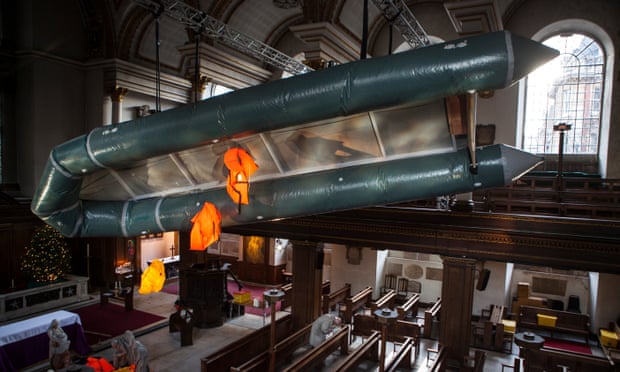
'Flight' by Arabella Dorman
Hanging from the vault of St James’ Church in Piccadilly, is an upturned refugee boat.  This dingy, designed to carry 15 people, transported 62 people from Turkey to Lesbos in Greece.  It is now an art installation by Arabella Dorman’s entitled Flight. The boat is suspended from the ceiling of the church, as if it were sinking down into the depths, and falling from its safety into the void are three life jackets: two adult-sized and one a child’s. The child’s has fallen further into the abyss, almost out of reach of the desperate parents.
So what does this have to do with Christmas?
You and I did not have any choice about when, where or how we came into the world. But God did.  And he left the comfort and splendour of his heavenly home, and chose to make himself weak and vulnerable, by being born as a human baby, totally reliant on others to feed and clothe him, to love him, care and protect him. 
He chose Mary, a young unmarried teenager, from a small, and insignificant village in Galilee to be the Mother of God.  And he chose a stable normally reserved for animals to be the place in which he entered the world, and for his bed a feeding trough. 
And the first witnesses to the birth of the Saviour of the World weren’t priests, or prophets, or politicians or Kings, people of power and influence but ordinary shepherds.  People who were looked down on by the rest of society, who because of their occupation were considered unclean, and therefore weren’t even allowed to enter the Synagogue or Temple.  Shepherds who weren’t even allowed to testify in court, because they were not trusted, and yet it was to these people that God choose to be the first witnesses of the birth of Jesus.
When God came into the world, it was in weakness and humility, so that he could identify and stand alongside the weak, the poor, the outcast, the stranger, and yes the refugee.  
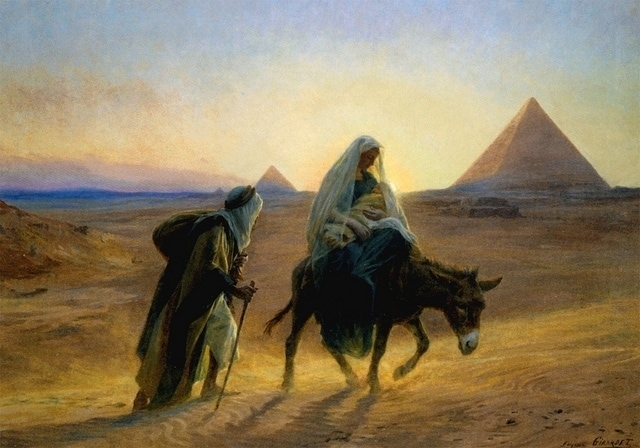
Flight into Egypt by Eugene-Alexis Girardet
Jesus himself knew what it was like to be a refugee.  He knew what it was like to face persecution, and to be forced from his home, like the tens of thousands of people in Iraq and Syria who have been forced to flee their homes to escape, persecution and death.  For Jesus the threat came from King Herod, who saw this small child as a threat to his throne.  King Herod, who had his wife and two sons killed, because he feared they were plotting against him.  So Mary, Joseph and Jesus were driven away from their home, to live in a foreign land. 
And even when Herod died, we are told that Joseph was afraid to take his family back to Judea, because Herod’s son Archelaus was ruling there, and so the family returned to Nazareth in the north.
Now understandably, we normally ignore the dark side of the nativity narrative. We have enough darkness of war and tragedy and refugees on our TV screens; some come to church at Christmas to escape from all of that and be reminded that Jesus is the light of the world. But Jesus can only be light if he shines where it is darkest.
When the angels declared the birth of Jesus to the shepherds they said “I bring you good news that will cause great joy for all the people.” (Luke 2:10)  It was into this dark and troubled world, that Jesus came to shine God’s light and love. 
The Christmas story is not some fairy tale, far removed from the reality of real life.  It is a real historical event that changed the world for ever.  And it is an event that has something important to say to a world where pain and tragedy, suffering and loss, is still a reality for many people, because Jesus, who is Emmanuel, God With Us, entered into the darkest places of brutal rulers and fleeing families. He walked a path of pain greater than probably any of us have experienced, culminating in his barbaric death at the hands of another brutal ruler, this time, one who was too weak-willed to protect a man he knew was innocent.
Sometimes people picture God lounging, perhaps dozing, in some celestial deck-chair, while millions struggle and die through war and famine and flood. But that is not the Christian God, that is not the God we worship this day. No, that terrible caricature of God in a celestial deck-chair is smashed to smithereens by the crib and the cross.
What’s your darkness at the moment? Maybe your darkness is job worries or relationship worries or health concerns. Whatever the darkness in your life at the moment, Jesus is God with us in the darkness.
And he brings light in the darkness - hope in the darkness - precisely because the darkness did not put Jesus out. Herod tried to extinguish the light of the world at his birth, but failed. Pilate tried to extinguish the light of the world at his death, but not even death could hold him down. So Jesus brings light in the darkness - hope in the darkness - because he’s confronted the darkness in our world and the darkness in our own hearts - he’s taken that evil onto himself, and let the darkness do its worst to him - and still he shines as the light for the world - light for you in your darkness.
Here’s the experience of one Syrian, who was forced to flee for his life after being threatened by ISIS fighters. Mathai walked from his home in Syria, to Damascus, across the border to Lebanon and into Turkey, then Greece. Traffickers put him on trains and a boat – a route where five people from his home town had previously drowned. He trekked through Macedonia, Serbia, Croatia and Hungary. He said, “Sometimes I was afraid, but mostly just so tired, so tired, so exhausted.” Two months ago Mathai finally arrived in Austria. Christians gave him a home and helped him apply for asylum. He was given an Arabic Bible. He said, “The Bible tells me I’m not alone, it reminds me that every human is loved by God and has a value. I’m very afraid, but when I turn to the Bible I see light. I particularly turn to passages in the Bible that are about forgiveness; it helps me when I think of all the people who have done awful things in my country, Jesus experienced the same and forgave his enemies. I am following Jesus.’’
Jesus brings light in the very darkest places. He wants to bring light in your darkness.  And he calls us to carry his light into the world, to follow his example and to stand in solidarity with the poor, the hungry, the frightened, the marginalized, the disadvantaged, the stranger, the outcast, the refugee.   
As the opening verses of John’s Gospel remind us, ‘In the beginning was the Word, and the Word was with God, and the Word was God.  He was with God in the beginning.  Through him all things were made; without him nothing was made that has been made.  In him was life, and that life was the light of all mankind.  The light shines in the darkness, and the darkness has not overcome it.’ (John 1:1-5)

May the light of Christ, shine in our lives, and in our world, now and forever more. Amen.

Sunday, 27 September 2015

Are we Sheep or Goats- Paddington Bear Matthew Chapter 25

Text of sermon preached by the Revd Phill Ball

“Then the righteous will answer him, ‘Lord, when did we see you hungry and feed you, or thirsty and give you something to drink? When did we see you a stranger and invite you in, or needing clothes and clothe you? When did we see you sick or in prison and go to visit you?’ “The King will reply, ‘Truly I tell you, whatever you did for one of the least of these brothers and sisters of mine, you did for me.’ Matthew 25:37-40

I settled down to watch the new film starring Paddington Bear. The film is as warm and welcome as a pair of slippers and you realize as you watch that Paddington Bear is a very important bear.

Michael Bond created Paddington in 1958. He says the inspiration for him came from seeing Jewish evacuee children pass through Reading station from London during the Kinder transport of the late 1930s. These were Jewish Children who had been whisked out of Europe before the Nazis had other plans for them. They were fleeing War and persecution, and as we now know extermination.


They all had a label round their neck, he says, with their name and address on and a little case or package containing all their treasured possessions. And so Paddington, in his blue duffle coat and red hat, has a sign round his neck from his relatives back in darkest Peru with a simple request: ‘Please look after this bear. Thank you’. 


In the film Paddington’s aunty sends him to England because, she says. ‘they won’t have forgotten how to give strangers a warm welcome there’. I wonder how many of you visiting this country still agree?  What happens is that Paddington gets into the train station and is pushed and shoved around, ignored and left by himself until, of course, the Browns take him in and he becomes part of that rather chaotic family. Paddington never looks happier, the marmalade sandwich never tastier, than when he realizes that he is at last ‘home’.I have the same initials as Paddington Bear, and my own experiences of marmalade sandwiches is of giving them to the prisoners under my care in various cell blocks, they weren’t all as happy as Paddington to receive them.

Now, for all the gathered extras over the centuries, the heartland of the Christian faith is the story of Jesus Christ. He is the gospel in person. Right from the very beginning of his life until he was publically executed, he was a stranger. He was a– born in an outhouse, visited by weirdos from funny places and rough Shepherds social outcasts, a child refugee in Egypt, and then later a preacher whose first sermon didn’t go down well and who then over three years disturbed the establishment by saying that God is more evident in the untouchables, overlooked and imperfect than in the religiously observant, or rich or powerful: even his closest family and friends constantly misunderstand him. When Peter says that he does not know the man as the cock crows, he is lying but he is also telling the truth. He doesn’t really know this man yet. This stranger was putting the odd back into God.This was not welcome. ‘He was in the world yet the world did not know him. He came to what his own and he was not accepted’.

This was strange as his Jewish People, had gone to Egypt as refugees from hunger in the time of Joseph, eventually been enslaved there and escaped as stateless and landless war refugees under Moses. Then been sent into exile under severe oppression under the Assyrians and Babylonians, and been second class citizens in their own lands under the Greeks and Romans. 

It should not surprise us then that for the early followers of this man Christ the Stranger it became very important to welcome the stranger. Jesus had told stories and had encounters where he opened eyes on how we project our fears onto people, often people who can’t speak out or strike back, the vulnerable in some way, and how we become tribal, liking our own types and pointing the fingers at others, and, oh how convenient, God is always on the side of our tribe. And yet, Jesus constantly exposed this religious fantasy for what it is – a blasphemy – and taught and lived to show that all, all, all, misfits, the unsure, the wounded, the unbeliever, the unclean, the totally different from you, all, ,and all of us here today, strange as we all are, are loved and  treasured by God equally and forever. If you are Christ-like you will see, like Paddington, that each and everyone of us here, each and everyone of us in this world, has a sign round our necks asking that you please look after me because I’m fragile, I'm bruised, I’m a bit scared, lonely sometimes, and I need a friend to help me through this life which frankly is not for beginners. Please look after this bear. I’m a bit of a stranger here.

I don’t need to tell you that we live in times when the stranger is fast becoming the enemy. The stranger in strange clothes, with different skin, with other sexuality, with opposite gender, with beliefs and thoughts not ours is being isolated so that the majority can look out at someone else and not in at themselves, so that we can have an easy answer to our complex problems. It happens in workplaces, schools, homes, churches and nations.

It happens in you and in me. But if you are here to follow Christ the stranger, if you believe like our earliest Christian sisters and brothers that you will meet Christ in the stranger because that meeting will make your world new and stretch you more open to God’s grace, then renew that commitment, renew it now, today, because the world badly needs a human heart that sees dignity before money, and a person’s need before appearance or place of birth. Because what will injure the stranger amongst us more that the words of their enemies will be the silence of their friends, the silence of those who taught that you will never recognise his followers by their vestments, doctrine or certainty but by their love.

At the end of the film Mr Brown is putting someone right about Paddington: ‘It doesn’t matter that he comes from the other side of the world. It doesn’t matter that he’s a different species or that he has a very worrying marmalade habit’. He saw that the Browns needed Paddington every bit as much as he needed them so Please look after this bear: for what you do to the least you do also to me says the Lord. Amen